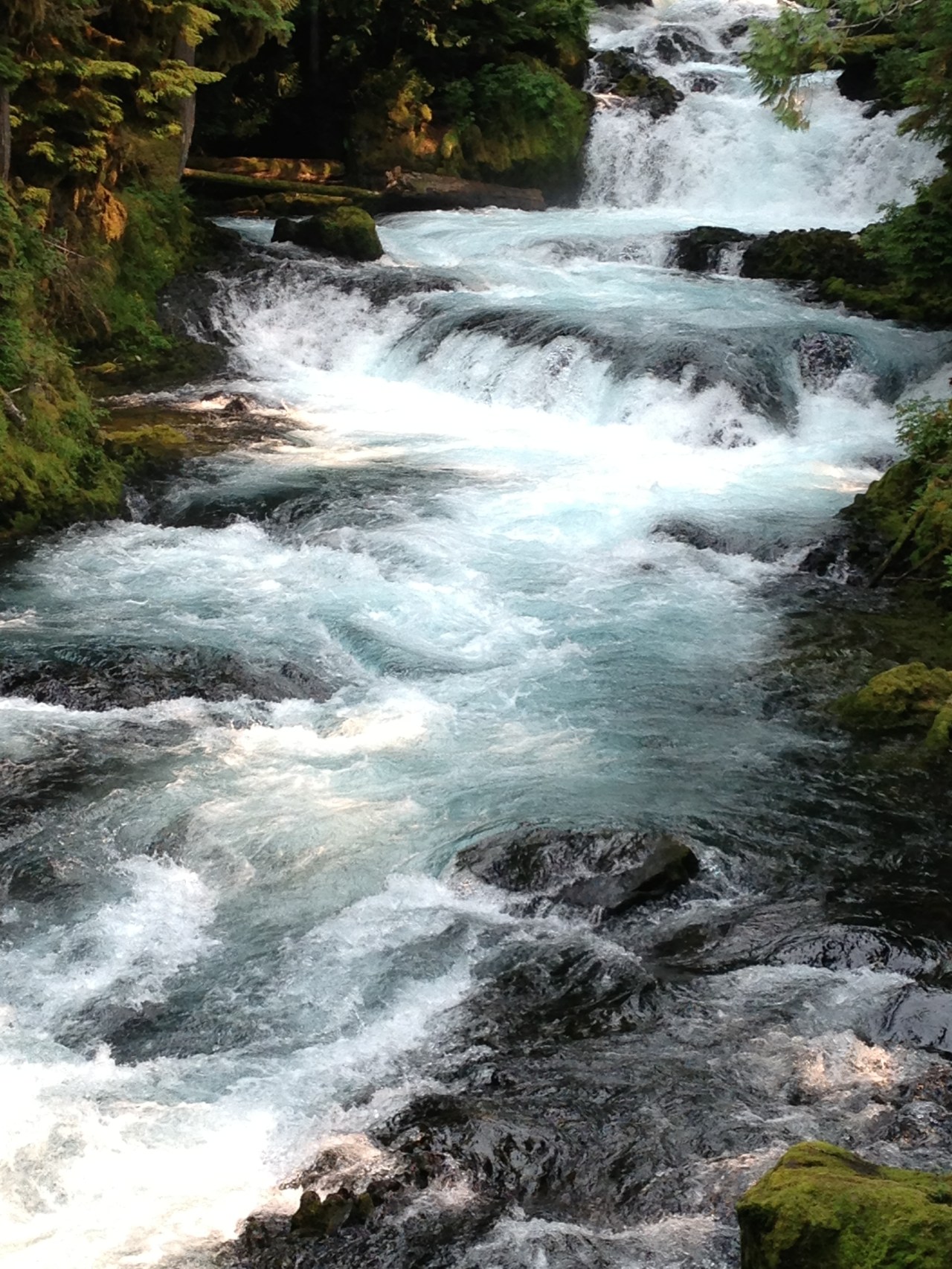
Mountain Berries

You didn’t mention

these just-ripe blackberries

when you told me about

this tree-lined trail.


Neither the smell of

them warmed by the sun

nor their impossible

color were noted


(a color which can

only be described as:

‘August Mountain Blackberries

In the Shade of Evergreens’).


Maybe these berries

weren’t here when you hiked

this trail; maybe you didn’t

witness their perfect ripeness,


and maybe it’s me

who should be detailing

their succulence to you,

sharing their perfection.


But I can’t just now

I think, rolling another

just-ripe berry into my mouth–

these berries remain


a secret the bears

and I share between us

in the stillness of (and in

fellowship with) these trees.

HERITAGE JOURNALS: STORIES COLLECTED BY 6TH GRADE STUDENTS OF JAQUI EICHER, 2002

Written by: Lynn and Claudia Hoefer

“Arriving in the Dever Conner Community on June 3, 1926, the day of my birth, I was just in time to grow up in the Great Depression of 1929. A trip to Albany down an old gravel country road in the Model T Ford car without a top was seldom and an ice cream cone was a real treat. Coming home by Bob Groshong’s house was steep drop off in the road, not a gradual grade as it is now, and my father would try to slow the Model T down with one foot on the brake pedal and one foot on the reverse pedal and would would still gain speed down the hill.

“There are many memories of my early days in Dever Conner such as fishing in Wilson Lake, riding on my father’s old horse-drawn water tanker on a hot afternoon down to Blackdog Landing where river boats landed and brought and loaded much of the things needed in the community. Blackdog Landing reportedly got its name from an old black dog that would lay in the landing and greet the boats when they came in. The tanker was to haul water for spraying pesticides on my father’s hop field and we had to run a pump by hand with a 4 foot wooden handle which we pushed back and forth for about an hour to fill the tanker. Going back to the farm, we would stop in the shade of an old plum tree and let the horses rest while we had our fill of plums.

“I attended Dever School which was heated by a very large wood stove, kept full of wood by one of the boys. This was a privileged job as it broke the monotony of school each time it needed fuel. There was usually only one teacher in the two-room school and 25-30 students in 8 grades and several subjects: recitation, spelling, flash cards. The teacher did it all, and even had time to read for 10 minutes or some other interesting book, which we all looked forward to. Our teacher was also the chief disciplinarian and I remember well one young lady who on more than one occasion would test the teacher’s patience and authority with argument and stubborn rebellion until she would be forced to stay in at noon recess to continue her punishment. Being boys with inquisitive tendencies, the four of us would go around to the back of the school building to an opening in the foundation and crawl there to the underside of the room to listen in order to find out whether she’d give in before she received a good licking. We’d emerge dusty and dirty, brushing our clothes off. I don’t know if the teacher ever got wise to use or not.

“There were only gravel roads then with potholes and muddy water. Walking to school my first two years, later riding a bicycle, was how we got to school, rain or shine. Going was easier than coming home as we were riding into the wind and rain, standing on first one pedal and then the other, barely moving, sometimes even having to get off and push our bikes.

“I never attended school at Conner School. The land was donated by the Conners (relatives of my father) but we had many pie socials and Sunday School meetings in both the Conner School and the Old Dever Store. Sometimes things would get very interesting when some of the older men at the pie-socials would bid some girlfriend’s pie up high, causing much laughter and embarrassment. My mother always taught Sunday School in these old buildings, which were no doubt the forerunners of Dever Conner Church, as we know it now.

“Occasionally the boys who had to devise their own entertainment would gather in our old hop dryers, with its many ramps and catwalks, gather up corn cobs left from the corn shelling (or snow when it would happen to come around) and a real fight would ensue. Sometimes boys several years our seniors would join in and this was alright until they would decide to soak the cobs in water. Corn cobs (and snowballs) soaked in water are murder if you get hit and things would get really rough till everyone was too tired or smashed to continue. Girls were not excluded but I can’t remember of more than one or two joining in.

“Evenings were long and cold in winter: playing checkers or listening to an old Victrola with a Kerosene lamp for light in front of an old fireplace for heat (neither of which adequately served their purpose unless you were up really close.

“Among other memories was sitting between my father’s knees on an old tracklayer tractor, learning to drive down the long rows of hops or sitting with my grandmother on our front porch on a late, hot summer evening, watching sparrow hawks flutter and make their long power dive with an airplane-like sound.

“We had an old horse-drawn wagon which I will never forget for when we took it out on the gravel road the old steel rims on the wooden wheels would vibrate until it seemed your head and teeth were not a part of you and you would stand on your tiptoes to soften the beating.

“Old Dever Store and the railroad stop where Dever Conner Road crosses the railroad were not in use since I can remember but the buildings were still there. Now they are completely gone. Morningstar Grange Hall (the land for it was donated by my wife’s ancestor) was the site for many functions of the neighborhood. Grange meeting, Saturday night dances, fairs, etc.

“As times improved, cars got better and gas could be afforded. We would get someone to take us to town in Albany and when the district could not afford a bus, neighbors would chip in and fund some old school bus or an old truck. Eventually paved roads came and modern cars too. Dever Conner today is a thriving farm community with all the modern things.

“Maybe of no interest to anybody but ourselves, I married a city girl, Claudia Hannon, whose grandparents lived next door to my grandparents in the Conner community in the late 1890s. Coincidence or not, we still live on some of the original property and love Dever Conner,”

HERITAGE JOURNALS: STORIES COLLECTED BY 6TH GRADE STUDENTS OF JAQUI EICHER, 2002

Life in Little Norway

“In the 1920s and ’30s there were several Norwegian families living in Evans Valley (Silverton, Oregon). Among them were the Rue, Langsev and Brenden families.

“All the neighbors would often walk together (20 or 25 people) to each others’ homes when there was birthday to celebrate. They brought sandwiches and goodies to share. They made lanterns from tomato cans because they were larger than other cans. Bailing wire made the handle and a candle inserted from the bottom made their flashlight. They played card games after dark.

“There were small farms through the valley. A truck from the Rose Valley Creamery in Mt. Angel traveled through the countryside, picking up mild cans that were left out by the road for them. If they needed butter, they would leave on big rock on top of the can. If they needed cheese, they left two rocks. They had tried leaving notes but they would blow away.

“The valley was a happy place in those days.”

Algebra

Afraid of life, she listens to

them tell her how different

she is; she takes it to heart

at first. Watch her try, try

try to be like them but

no matter how hard she tries,

she is not like them.

Somewhere along the equation

she realizes that different than

is not less than;

it is equal to. Sometimes (maybe

mostly) different than, plus

different than equals a sum

far greater.

Up From the River Smiling

A friend once told me she met

her future husband just after

a turbulent river tossed

her out of her small kayak.

My friend, being who she is, showed

up from beneath the icy water

laughing — her bright smile stretched

across her triumphant face.

The man, knowing his own need,

asked, “who is this woman

that came up from dangerous

water smiling?”

He asked to meet her on dry ground.

They loved well and married,

carried out to the sea of life

by that river-smiling moment.

I wonder how I, being who I am,

could meet another who is able

to come up from the river smiling.

I’m familiar with icy water, dangerous

and turbulent; I watch it carefully,

hopeful to someday see the one

who comes up from the river

with a smile on his face.

HERITAGE JOURNALS: STORIES COLLECTED BY 6TH GRADE STUDENTS OF JAQUI EICHER, 2002

“I graduated from Jefferson High School in 1944, in a class of 14. Two of my classmates were already in the armed services.

When the war ended, my sister went back to Nebraska to be with her husband but I was in love with Oregon, so I stayed here. Fortunately some very good people: Lettie Stansberry Mixell and Bud and Laura Wattenbarger, took me in and sort of looked after me. They became life long friends. Eventually I married James Wied, whose grandparents homesteaded a lot of land around Jefferson. They were also related to Jacob Conser, who founded the city of Jefferson, which was first named Santiam City (and it was on the other side of the river). There was no bridge, so the only way to cross the river was by horse-drawn ferry. Eventually there was a flood and Santiam City was no more. It was re-named Jefferson. Jacob Conser built the house which is now the library.

A doctor would come to Jefferson by train. When the mother of my husband and his two sisters was 13 years old, a young man was enamored of her, but she rejected his advances. He brought a note to her class room saying someone outside wanted to see her and when she got outside, he hit her in the head with an axe and buried her in the wood pile. Fortunately it didn’t kill her. He was apprehended and served a long jail sentence. However Lulu died quite young as a result of the injury. I learned of this incident after I married into the Wied family and read many reports of it when I was doing genealogy research. Some of it even appeared in the San Fransisco papers.

Jefferson has grown a lot residentially in the last years, but not as much business-wise. Of course some of us like the small town flavor!”

–Marcella King Wied

HERITAGE JOURNALS: STORIES COLLECTED BY 6TH GRADE STUDENTS OF JAQUI EICHER, 2002

Tobogganing When I Was a Boy

East of Salem there is a small community called Pratum. This is where I grew up. About 1/2 mile East of Pratum there is a river called the Pudding River.

One Winter day it snowed a lot–12 inches–and it was cold, as the snow did not melt.

A group of boys, including my older brother (6 years older than I), had a toboggan which would hold about 5 fellows. We got it out and started going down a nice hill toward the Pudding River. There was an old rail fence made out of wood at the bottom of the hill, next to the river.

When we went down the hill we would stop approximately 100 or 150 feet short of the rail fence. “Oh, what fun!” We were having a great time when the older boys came and took the toboggan. When they got tired of it, we were back at it again.

That evening they got buckets of water and put it on the hill. The temperature was cold, so the water turned to ice.

Well, the next morning was Saturday, so no school. Us little guts got up early and beat the older boys to the toboggan. We were having lots of fun and would stop before the rail fence. The older boys came and took the toboggan away from us. We thought that was so mean. They got on the toboggan and went down the hill just zooming. When they got to the bottom of the hill, they couldn’t stop. They went right through the rail fence and onto the ice on the river. The ice was not thick enough to hold all the weight and they broke through the ice. All the boys went in the river. The water was only about three feet there, but they all got sopping wet.

Well, do you know what? Us little guys were able to toboggan the rest of the day. The older guys had had it. This happened about 1940. “Oh, what fun!”

–John Wenger

HERITAGE JOURNALS: STORIES COLLECTED BY 6TH GRADE STUDENTS OF JAQUI EICHER, 2002

The Chambers Family

We are all in the Surburban which is loaded with 5 bikes, 2 sets of golf clubs on the roof, heading NW out of Death Valley towards home, the Willamette Valley. We are considerably browner and hopefully more rested than one week ago, although that is up for debate.

I will begin this journal entry with a quick survey of Oregon memories from my childhood. When I was young my dad worked for a finance company and got transferred a lot. We lived in Newport of several years and I remember mom being continually frustrated by sand in the house. My brother, Kevin, disengaged the gear shift on the car in our steep driveway and when it started rolling, he jumped out, catching his jacket on the door handle and was thrown under the wheels. Kind of a bizarre memory, the but the kind a child remembers. My mom had to scrub his scalp and pick gravel out with tweezers. It was not a fun time.

In Newport I also remember the big Columbus Day storm. We were all with our babysitter at home waiting for Mom to get home from her job in Depoe Bay. I recall the howling winds and our screen door blowing off in the wind and flying down the street.

We lived in Toledo next and I remember our black dog Lady having a litter of pups. They were so cute and that is when I developed my affection for puppy  breath. I also have a fond memory of learning to iron at about age 4–my dad’s handkerchiefs when he went away on a business trip. He praised me and made a big deal about the good job I did.

Next we moved to a house on Siltcoos Lake. It was an awesome place with a huge patio overlooking the lake and our dock. There was a bit of decline to the lake and the yellow Scotch Broom that covered the hillside glowed at sunset. Our dock had some logs that were attached forming a triangle. I remember bobbing for hours at a time with a life jacket on while my dad and his brothers fished. Fishing was so good; they would take clothes baskets down and fill them with Bass, Crappy and Blue Gill. I spent hours studying the lily pads that bloomed around the edge of the lake. I thought they were so interesting–how the roots came up through the murky water with pads and beautiful floating flowers. It is interesting how certain things you encounter through life take root. In later years I became a competitive swimmer because of a love of water that I’m sure developed while bobbing in the lake and also, I took the first of many painting classes because I wanted a painting of lily pads (which is hanging on a bedroom wall in our cabin).

I remember picnics at Honeymon Parkin Florence. If you’ve never been there, the park has a wonderful lake surrounded by sand dunes. We would run down the dunes and plunge into the lake until we were exhausted.

Then we moved to Reedsport where I started first grade. The only thing I remember about the school is that my boyfriend, Timmy Timchuck, gave me an Indian Head ring. Out behind our home we had a small creek. I spent hours watching and catching tadpoles and salamanders. They fascinated me. . . the way the legs grew on fishy bodies. While we lived in Reedsport, the great flood of 1964 hit. I remember going to my grandparents during the flood which I loved. Going to my grandparents in Aloha was always the most fun. At the time, it was hard to understand why everyone was so serious, but having now experienced the big flood of 1996 first hand, I can totally understand.

We moved from Reedsport to Lebanon midway through my first grade year. I went to St. Edwards School were the nuns taught us a strong phonics based curriculum that I have always appreciated. I recall playing “Heads Up, Seven Up” at our desks after lunch on wet winter days. I also remember reading our Weekly Readers about inventions we’d see in the future. They showed how vehicles would look in the future. They were sleek aerodynamic spaceship looking rigs that I unbelievingly marveled at. We now see these predictions by the hundreds. We call them mini-vans! I also recall reading about telephones in the future that would have a monitor where you could see the person you were talking to. The idea was so futuristic; it was hard to imagine by one of our computers now has an eye-cam that allows one to see the person they are conversing with on the internet. What inventions will our kids own as adults that are too unbelievable to imagine to us now?

While we lived in Lebanon we had heavy snows that stacked up to be 3.5 feet deep. My brothers and sisters and I made tunnels through it. We felt so sorry for the birds who couldn’t find food and died in the snow so we fed them for a week while the snow slowly melted.

After 4 years in Lebanon, we moved to Albany where we bought a home on Calapooia Street, right next to Henderson Park. It was a fun place for a kid to live because there were always kids to play with. Back in those days, Albany Parks and Recreation had summer programs at all the city parks in town where a college student was hired to run an activity program for any kids whom wished to participate. They had daily crafts where everything was provided free of charge. We played lots of games and went on short field trips to places around town. It was great fun and kept many kids occupied. A person has to wonder why so many programs that were funded back then are no longer possible. All the neighborhood kids would congregate at the park on warm summer evenings and play Kick the Can. It was exciting sneaking through the dark trying to avoid getting caught. We all had an open-door policy and spent a lot of time at friends’ homes.

Talking to some of those same friends in recent years–they have remembered how they loved coming to our house because my mom always had a huge pot of spaghetti sauce simmering (which she was famous for) and everyone got a spoon to sample. They also loved the hours we spent in our living room where my mom gave Polka lessons. We’d move all the furniture out of the way, crank up the stereo to one catchy Swedish tune or another, and we’d all be twirling around laughing and getting sweaty. The little kids would stand on Mom’s feet so they could get the feel of it. Everyone called my mom the “Mother Bear.”Years later, when we had kids of our own, they called my mom, “Nanna Bear.”

Our neighborhood was close to downtown Albany. It was very different back then. The downtown area was alive and thriving as no malls or big shopping centers existed yet. Two Rivers Mall where the Wine Depot Deli and Pastabilities are  used to be Payless Drugs. It was the place to shop because hadn’t been built yet. J.C. Penney’s was thriving in a building on First Street that is now an antique mall. The Venetian Theater had movies that all the kids went to on Saturdays. There was nothing better than an orange Crush Soda and a box of Flickets. Cleo’s was a favorite hole-in-the-wall next door to the Venetian where we’d go for inexpensive burgers. Also downtown, the library (which is now the historical library) used to have lots of kids supposedly working on projects for school, but I think they were there mostly to socialize.

The kids in the neighborhood would often times ride their bikes the five mile loop through Bryant Park to Riverside Drive, past West Albany High School and back to the park. We’d all take our swimsuits and stop off at one of the two swimming holes on the Calapooia River which was along the way. There were tree swings that dropped off into deep pools. It was such an adventure. Times have definitely changed because I’d never allow my kids to do things like that without an adult supervising.

Many of the kids in the neighborhood picked strawberries and pole beans in the summer to help earn money for school shopping. We’d catch a bus and go to different farms–Hoefer’s, Schlegel’s and Chamber’s–to labor away sunny summer days. Little did I know that Hoefer and Schlegel would become good friends or that I’d marry a farmer named Rod Chambers! We had a lot of fun in the bean field. The tall pole beans provided lots of cooling shade. I never made more than $5-$6 a day but it added up. And we couldn’t forget the entertainment. One kid, Scott Sprague, stood on top of his 5 gallon bucket and chewed up a huge handful of beans until it became green slime. Then he’d slightly bend over and let the green saliva start to drip towards the ground. When it would get close to the ground, he’d slurp it back up into his mouth. He’d continue this for long periods of time while we all rolled around on the ground in fits of laughter. Perhaps that’s whey I only made $5-$6 a day?

My journal entry isn’t chock full of historical trivia but more personal memories. These events that I’ve told you about Abby all helped mold me into the person I am today and in turn they have carried over in motherhood as I raise you, Justin and Josie. It’s fun to think about all the childhood memories you are presently creating and which of our family adventures you’ll laugh at as you retell them to your own children. Dad and I love you a lot and are proud to have the three wonderful kids that we do.

–Respectfully Submitted, With Love, Kim Chambers

HERITAGE JOURNALS: STORIES COLLECTED BY 6TH GRADE STUDENTS OF JAQUI EICHER, 2002

Happenings of Earl Days At Old Dever School, Dist. No. 20

“My first teacher was Rebecca Crooks (Hoefer), a very sweet lady till the day we were marching into school in a double line and Bertha Skelton (Barnes) suddenly vaulted right over Eva Hooper’s head. Frank Asche was sent back of the school yard for a hazel and Rebecca went into action.

“Another teacher was Elmer Nash who boarded with Joe Jones family. He would watch Mr. Jones set pies in her pantry window to cool and when no one was looking he’d steal a pie, then watch Mary Jones punish her kids, Fred, Frank, Nellie and Myrtle.

“When Ada Cowls was teacher, Bill Hoefer often visited the school. Youngsters were not supposed to know why he was so interested in school. One day when Bill was visiting, the Asche twins (Freda and Lena), Jake Gilmour, Nelson Gilmour, Wayne Kelly and Della Asche marched up to the platform and sang: Can she bake a cherry pie Billy Boy? Blonde Ada was scarlet and furious.

“The Gilmour boys and Wayne Kelly usually teamed up together. One day as teacher sat down, she leaped straight up, demanding to know who put the needle in her chair. Three boys stood up to take the blame. Jake was asked to come forward and put the phonograph needle in the cane bottom chair exactly as it was placed for the teacher. ‘Now Jake you sit down,’ he was told. He carefully sat forward and slid back into the chair pushing the needle as he sat. She next tried to shake Jake but he was as large as she and so very limp, she could do nothing.

“There were no modern play things. A Flying Dutchman was always fun. This was a pole fastened on top of a stump with a spike or wood pin. The big boys would run around at top speed while all who could would hang on. The little kids eager to get in on the fun would run in while the log was in motion and get knocked down. One Monday we viewed the sad remains of our Flying Dutchman. Mrs. Jones and Fred had gone to school on Saturday with axes and chopped stump and pole into bits. After that we had to be satisfied with a teeter board through the old rail fence.

“All attractions were not at school. As we walked by Ed Chambers on wash day we used to stop and watch the big old Angora goat doing the family washing. To make Luella’s wash day easier Ed built an incline for the goat to walk up. This turned a pulley fastened to the washing machine. When he got tired he would brace his feet, some one would have to get him started from the rear. The washing would proceed until his next rest.

“One of Dever’s present Grandmothers loved to steal the boys bicycles and ride west. One day three boys waylaid her; in a fence corner they proceeded to pants-guard on her. This would be fine in modern overall attire, but in those days the girls all wore dresses.

–Della Ede

In The Unraveling

Thread that binds us

is impossibly strong;

we are more closely knit

than we can fathom

(even if we do try

to deny this often).


Seams sometimes split;

some places need

more mending and tender

care. In mending, time

has a strengthening way

of altering the original.


Sometimes in the unraveling

we find and follow

the thread that binds us;

it’s then we see how

strong we are and what

we have been together.