Algebra

Afraid of life, she listens to

them tell her how different

she is; she takes it to heart

at first. Watch her try, try

try to be like them but

no matter how hard she tries,

she is not like them.

Somewhere along the equation

she realizes that different than

is not less than;

it is equal to. Sometimes (maybe

mostly) different than, plus

different than equals a sum

far greater.

The Enclosure of the Heart

Like a sprouting seed, love climbs

the enclosure of the heart

that has at last allowed

the light of grace to reach it,

tendrils — fragile and leggy —

pull it up and out

of its dark place,

deep in the dank ragged

edges of loneliness

until it flowers, spilling

all its fragrance and color

on any one who will stop and listen.

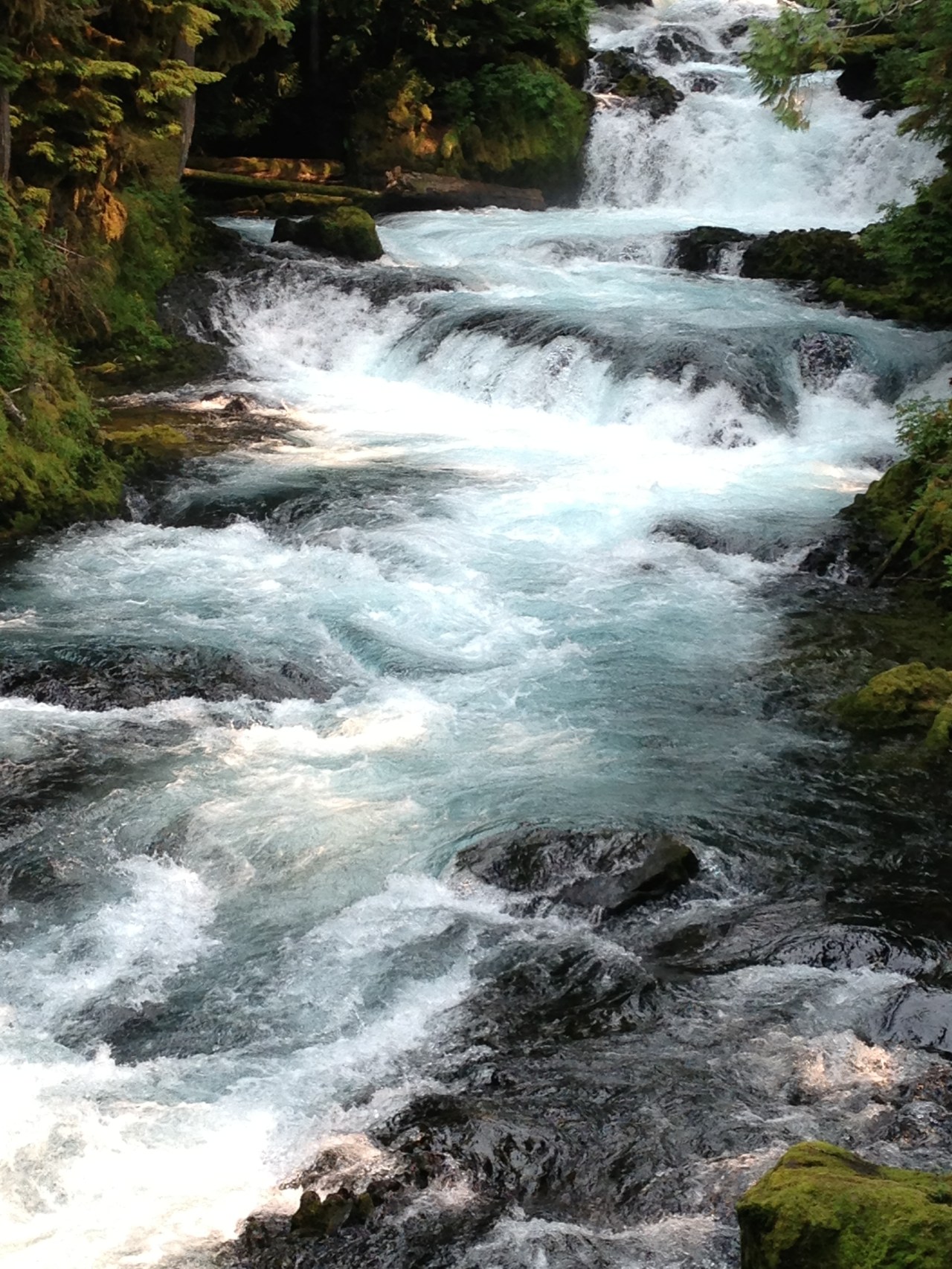
Up From the River Smiling

A friend once told me she met

her future husband just after

a turbulent river tossed

her out of her small kayak.

My friend, being who she is, showed

up from beneath the icy water

laughing — her bright smile stretched

across her triumphant face.

The man, knowing his own need,

asked, “who is this woman

that came up from dangerous

water smiling?”

He asked to meet her on dry ground.

They loved well and married,

carried out to the sea of life

by that river-smiling moment.

I wonder how I, being who I am,

could meet another who is able

to come up from the river smiling.

I’m familiar with icy water, dangerous

and turbulent; I watch it carefully,

hopeful to someday see the one

who comes up from the river

with a smile on his face.

The Color of Your Heart

(Written for my art students at Howard Street Charter School, 2012)

The color of your heart is deep and wide–

It gathers all around me

And fills my days with laughter rich

And teaches me to be

More colorful myself, spilling all

My deepest hues

(Those I tend to hide inside)

Instead of showing them, like you.

Together we can paint the world to

Create a masterpiece

Of love and harmony and then

Our world can be at peace.

Some of Us Crawl

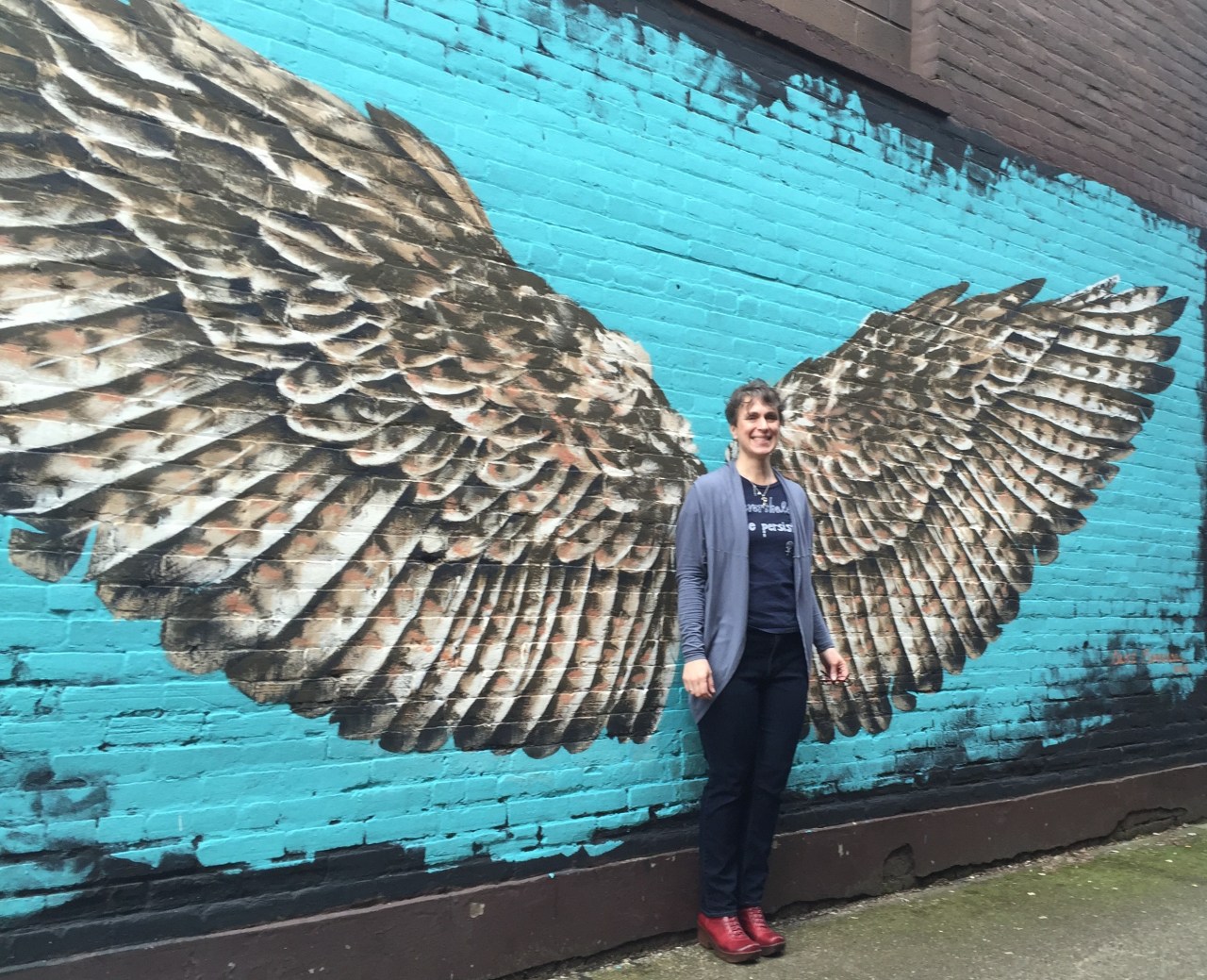
“It is legitimate to crawl after the wings are broken.” William Stafford


To have wings is to have hope.

So much like a bird,

hope soars overhead, urging

us all (those of us broken and hopeless)

to look up; look out of ourselves.

But it seems too easy to look in

and see the ragged absence of wings.


Though some of us do crawl.


I crawl, dragging myself forward.

The shadow in my path, gone first,

then returning.

I look up–

There is a surge of joy in me!

To see hope like this is to see the future.

HERITAGE JOURNALS: STORIES COLLECTED BY 6TH GRADE STUDENTS OF JAQUI EICHER, 2002

Tobogganing When I Was a Boy

East of Salem there is a small community called Pratum. This is where I grew up. About 1/2 mile East of Pratum there is a river called the Pudding River.

One Winter day it snowed a lot–12 inches–and it was cold, as the snow did not melt.

A group of boys, including my older brother (6 years older than I), had a toboggan which would hold about 5 fellows. We got it out and started going down a nice hill toward the Pudding River. There was an old rail fence made out of wood at the bottom of the hill, next to the river.

When we went down the hill we would stop approximately 100 or 150 feet short of the rail fence. “Oh, what fun!” We were having a great time when the older boys came and took the toboggan. When they got tired of it, we were back at it again.

That evening they got buckets of water and put it on the hill. The temperature was cold, so the water turned to ice.

Well, the next morning was Saturday, so no school. Us little guts got up early and beat the older boys to the toboggan. We were having lots of fun and would stop before the rail fence. The older boys came and took the toboggan away from us. We thought that was so mean. They got on the toboggan and went down the hill just zooming. When they got to the bottom of the hill, they couldn’t stop. They went right through the rail fence and onto the ice on the river. The ice was not thick enough to hold all the weight and they broke through the ice. All the boys went in the river. The water was only about three feet there, but they all got sopping wet.

Well, do you know what? Us little guys were able to toboggan the rest of the day. The older guys had had it. This happened about 1940. “Oh, what fun!”

–John Wenger

HERITAGE JOURNALS: STORIES COLLECTED BY 6TH GRADE STUDENTS OF JAQUI EICHER, 2002

Jefferson Then

My family moved to Jefferson in the Spring of 1946 from Southern California following World War II. My father worked in the shipyards and my mother ran a boarding house there.

We came to Oregon so the family could work in the fields which we did, starting with strawberry picking, mint hauling, bean picking, corn picking, etc as all were done by and before mechanization of those crops. There was no minimum age limits, so we all could work, and did all summer. We were all responsible for making enough for all school clothes and expenses. When we came to Jefferson, there seemed to be a lot more business than today.

Downtown had a Confectionary where we could go for ice cream, milk shakes, etc. There was a drug store, Doctor, Theater, two active lodges (Masons, Eastern Star Oddfellows and Rebeccas), a blacksmith, variety store, several grocery stores, several service stations and cafes, just to name the first part of the business area.

The “Terminal” was on the highway (Second Street) and was the bus terminal as Greyhound busses came through regularly. This was prior to the construction of Interstate 5 and highway 99 was the main north/south highway going through Jefferson.

Having been born on the Texas Plains and raised in Southern California among the Palm Trees, the thing that amazed me most was how high the fir trees grew! And I never knew that mint was a farm crop.

I have lived in Jefferson now for 57 years, married a Jefferson born native, raised a family, worked and retired in Jefferson and have see many, many changes take place in town. Major businesses destroyed by fire include the Evangelical Church, the Mari-Linn Co-Op and Freres Lumber Company, each of which have been replaced except the Co-Op.

A bank came to Jefferson in 1963, a new post office in 1960 and again in the early 1990s.

In 1946 there was one school that included all 12 grades. Now there are three schools as the population has grown to require a grade school, middle school and high school. Jefferson will continue to change.

–Margaret Hire Knight

HERITAGE JOURNALS: STORIES COLLECTED BY 6TH GRADE STUDENTS OF JAQUI EICHER, 2002

When I was asked to write a story about Oregon, my thoughts went back to the time when I first came to teach school in the town of Jefferson. Yes, to be exact it was but a wide spot in the road but it was an important wide spot. Why? Well it’s importance stemmed from the fact that it was situated on the two main arteries of travel–the railroad and the highway. At that time much of the passenger traveling was done by rail for buses were just beginning to come in to use. Most of the trains were made up of freight cars and passenger cars. The trains made regular stops at the station which was located at the east end of Church Street. The men working for the railroad company picked up freight that was being sent out as well as outgoing mail and deposited freight and mail being delivered to Jefferson residents. Travel was so different in those days for the pace of travel was far less speedy than it is today.

This is not a very interesting story by perhaps it will give an idea of what traveling conditions were like seventy years ago. The automobile industry has made such a deep impression on our mere existence in this world. We must stay alert just to keep up with the crowd.

It might be of interest to readers to compare our methods of travel to that which was used by the early settlers of this area. The method of travel used by the great grandfather of my husband, Gilbert was the covered wagon. Jesse Looney came to the Willamette Valley in 1843 to look this area over, then he returned with family and some friends to make a home in the area that is now known as the Looney Butte area. He staked a land claim and later staked claim for his children when they came of age.

It was shortly after my arrival here in 1930 that I met Gilbert Looney and in 1933 we were married and for the life I’ve had in Jefferson I am truly grateful.

–Geraldine “Gerry” Looney

HERITAGE JOURNALS: STORIES COLLECTED BY 6TH GRADE STUDENTS OF JAQUI EICHER, 2002

Conner Community

“My name is Dee Chambers. I moved to the Conner Community with my parents Elmer and Jennie Chambers and two sisters when I was in the fourth grade. We moved into a shack of a house with only one light bulb and  no running water. The toilet was out back of the house. The house was a board and bat construction. That is: wide boards were nailed on to the frame vertically and narrower boards were nailed over the cracks between the wide boards. The house was situated in the place where Larry Langmade now lives at the East end of the Dever-Conner overpass. The walk to Conner school every day was about a mile each way.

“My closest friends at that time were the Miller boys who lived North of what is now Higbee Drive. The house they lived in had to be moved when Interstate 5 was built. So Lynn Hoefer purchased it and moved it to its present location where Lynn and Claudia Hoefer still live. In the summer we used to go swimming at the bluff on the Santiam River. More about the bluff later. We only lived here for about a year, then my parents bought a farm in the Jefferson area so we moved to Jefferson. After we were there for about a couple of years, World War II ended and a young fellow (his name is Dale Turnidge) came home from the army and wanted my parents’ farm so they sold it and bought another one back in the Conner community. We moved back there across the road from the Davis family. The Cook family was just down the road a short distance as was the Pesheck family. It was back to Conner School again and it was a mile walk each way. And that’s where I grew up.

“Conner School was a two room school: 4 grades in each room. I graduated from the 8th grade at Conner then went to high school in Albany. I finished high school and started farming. Many years later, when my parents quit farming, I purchased their farm and moved into the house they had built in 1951. Many years later I sold the farm to my son who lives there now with his family.

“When I was going to school at Conner, the school was heated with a wood stove, so the older boys got the job of going to school early and took turns one month at a time to start the fire in the stove. That way the school would be warm when the teacher and the rest of the students got there. We got $5 a month from the school board for this chore.

“A couple of things I remember about growing up in the Conner Community:

“We went swimming at the floating bridge. The Turnidge family had a farm on both sides of the Santiam River on what is now Don Turnidge’s farm in Linn County and Keith Johnston’s farm in Marion County. They build a pontoon bridge across the river. It was just  a couple of big logs with boards nailed across it. It was anchored to each bank with heavy cables so that you could drive on it. It was a great place to swim–we had a lot of good times.

“Another thing I remember is the ball games. The community liked to play softball. So much in fact that Albert and Walter Harnisch built a ball diamond for us just South of where Craig and Beth Christopherson now live on a piece of ground that was though to be too rocky to farm. It is now planted to blueberries. The Harnisch men even put up lights for us so we could play in the evening after work.

“Back to the bluff: it’s where the Santiam River and Bluff Road meet. It has always been called The Bluff by everyone in the community. I don’t know this for a fact, but I was told this by some of the old timers who would have known. Many years ago, sometime in the mid 1800s, across from The Bluff, on the Marion County side of the river was Syracuse City. There was a ferry there that hauled people and their goods across the river. This was before there were any dams and flooding was a regular occurrence. One winter a real bad flood happened and washed the town away. The people living there decided that perhaps it was not a good place for a town. So it was not rebuilt. Instead they built a new town up river on higher ground and named it Jefferson.

“Having lived in the Conner community now for almost 60 years I can say it’s been a good place to grow up, live and raise a family. A lot of changes have taken place in the period of time. A lot of people still think of us being out in the country, but the city is getting closer all the time. Why, city water is only three miles from our farm now. It’s certainly not the country I remember as a kid growing up. By the way, I forgot to mention that I am Abby Chamber’s Grandpa. I can’t help but wonder when she is my age and looks back at the Conner community what changes she will see; what memories she will have. I trust they will all be good ones.

–Grandpa Chambers

In The Unraveling

Thread that binds us

is impossibly strong;

we are more closely knit

than we can fathom

(even if we do try

to deny this often).


Seams sometimes split;

some places need

more mending and tender

care. In mending, time

has a strengthening way

of altering the original.


Sometimes in the unraveling

we find and follow

the thread that binds us;

it’s then we see how

strong we are and what

we have been together.