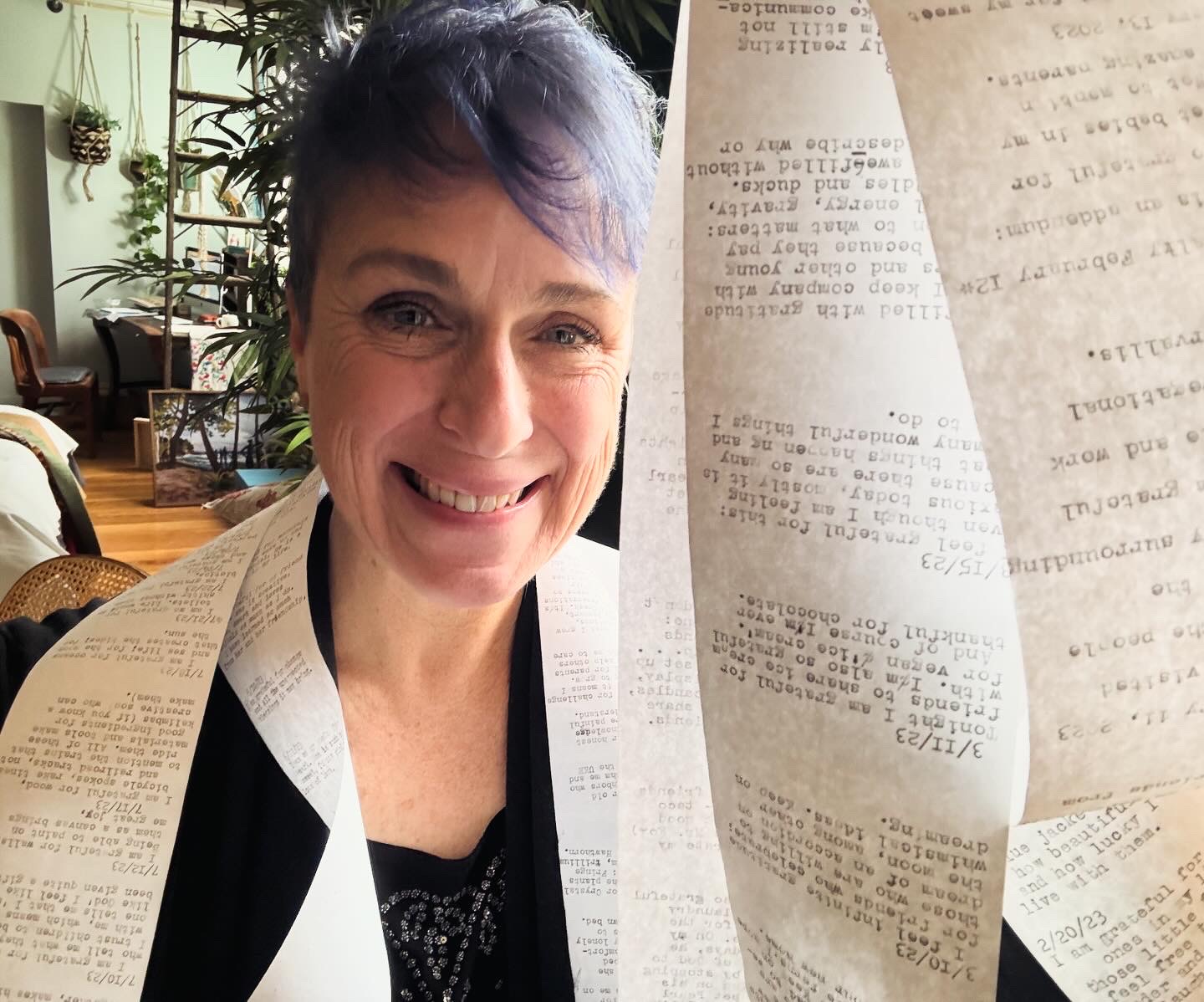
My Type of Gratitude List, No. 6

July 1, 2023: I am grateful for the number one, which does not exist on this typewriter. I use the Roman Numeral. Of course this leaves me so grateful that I am able to improvise.

July 4, 2023: I am grateful for friends who understand my sensitivity to sound as well as Pearl’s special sensitivities. This is a challenging day for us and I am grateful for friends who respect us and understand.

July 5, 2023: I am grateful for language. Also, I am grateful for a certain 2 year old who loves language so much that the words cocoon and raccoon, when said together, makes him laugh.

July 10, 2023: I am grateful for children who tell me what they think. I trust children to be real with me, which means when one tells me I smile ‘like God’ I feel like I’ve been given a gift.

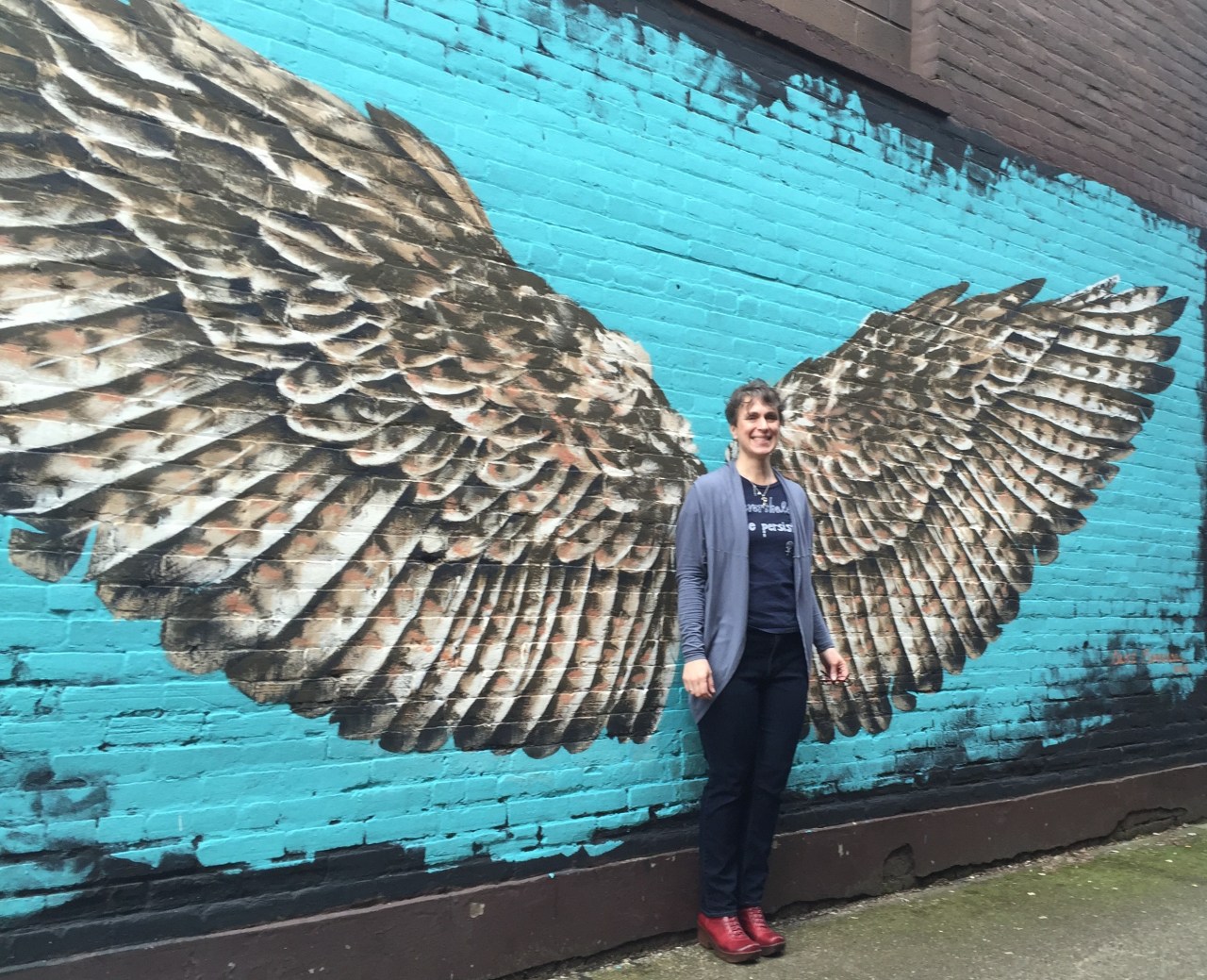
July 12, 2023: I am grateful for walls. Being able to paint on them as a canvas brings me great joy.

July 17, 2023: I am grateful for wood, bicycle spokes, rake tines and railroad tracks, not to mention the trains that ride them. All of these materials and tools make good ingredients for kalimbas (if you know a creative soul who knows how to make them).

July 18, 2023: I am grateful for the ocean and sea life; for the moon that creates the tide; for the sun.

July 21, 2023: I am grateful for toilets. Life would be shitty without them.

July 22, 2023: I am grateful for antibiotics.

July 24, 2023: I am grateful for avocados and those who harvest them.

July 25, 2023: I am grateful for perfect, ripe blueberries.

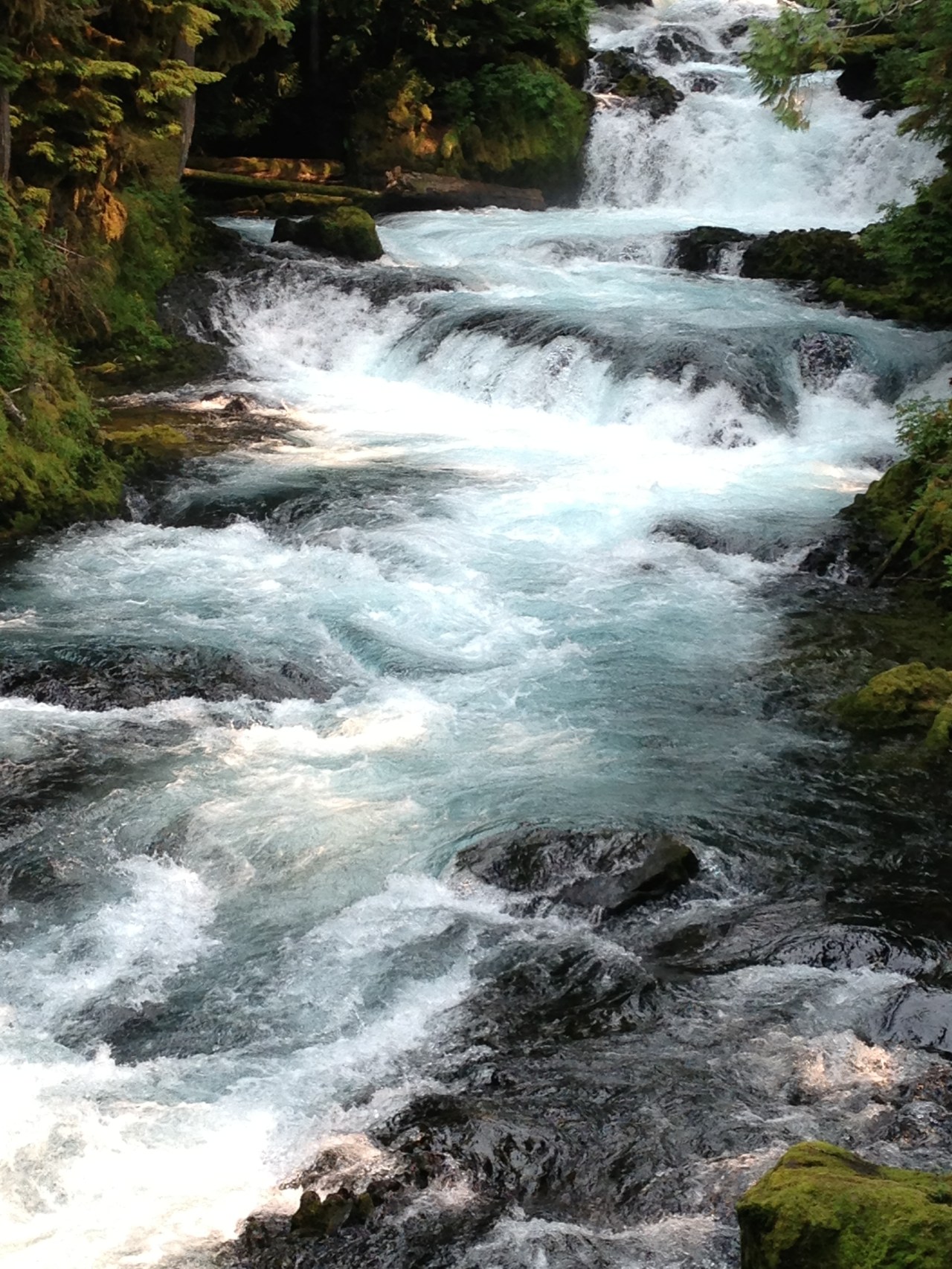
July 26, 2023: I am grateful for rivers and the water that defines them.

July 27, 2023: I am grateful for tea, and Japanese made glass tea pots that allow me to watch the leaves unfurl.

July 31, 2023: I am grateful for fresh figs, ripe and straight out of my friend’s yard to my door. I have never tasted candy so delicious.

HERITAGE JOURNALS: STORIES COLLECTED BY 6TH GRADE STUDENTS OF JAQUI EICHER, 2002

Written by: Jerry Cox Nicholson, great-great-great grand daughter of Jesse and Ruby Bond Looney

“Jesse Looney was born near Knoxville, Tennessee and spent his youth and early manhood in the South. He was a first cousin of Andrew Johnson, President of the United States.

“Jesse Looney inherited land and many slaves as his heritage. Slavery was one of the local conditions under which he was reared, but early in life he espoused the idea of human freedom and decided to leave the land of his birth and its tradition of human slavery. He sought a place where he could rear his family under better influences. Jesse, with his wife and six children, joined a wagon train made up of many families. With Dr. Marcus Whitman as their captain and guide, they headed for the Oregon Country. They started on May 22, 1843 from Independence, Missouri and arrived in October of that year in what is now called Jefferson, Oregon.

“Jesse Looney showed his good business judgement in fitting out his family wagons. There were three. One was built like a boat, with a tight bottom, so as to ford the streams without getting the contents wet. One was called ‘fiddle’ because of its peculiar construction. In these wagons they had packed everything they could think of that they would need in the new country.

“Jesse and his wife Ruby Bond Looney chose for their donation claim a beautiful location about twelve miles south of Salem, known later as ‘Looney Butte’. The Looney cemetery is only 1/4 mile from this home and Jesse Looney (1802-1869) and his wife Ruby Bond Looney (1808-1900) are both buried there.

“Jesse Looney packed the wagons for their new home in Oregon Country. A jar of apple seeds was a dream for their new land. Jesse developed one of the largest orchards in the new country. When the apple trees all came to bearing, folks came all the way from California to get apples.

“The old Jefferson Institute which was located near where the present elementary school now stands was in operation from 1857-1899. The first enrollment was 89 pupils. Courses were taught from the elementary level up to the equivalent of two years of college.”

Algebra

Afraid of life, she listens to

them tell her how different

she is; she takes it to heart

at first. Watch her try, try

try to be like them but

no matter how hard she tries,

she is not like them.

Somewhere along the equation

she realizes that different than

is not less than;

it is equal to. Sometimes (maybe

mostly) different than, plus

different than equals a sum

far greater.

The Enclosure of the Heart

Like a sprouting seed, love climbs

the enclosure of the heart

that has at last allowed

the light of grace to reach it,

tendrils — fragile and leggy —

pull it up and out

of its dark place,

deep in the dank ragged

edges of loneliness

until it flowers, spilling

all its fragrance and color

on any one who will stop and listen.

Up From the River Smiling

A friend once told me she met

her future husband just after

a turbulent river tossed

her out of her small kayak.

My friend, being who she is, showed

up from beneath the icy water

laughing — her bright smile stretched

across her triumphant face.

The man, knowing his own need,

asked, “who is this woman

that came up from dangerous

water smiling?”

He asked to meet her on dry ground.

They loved well and married,

carried out to the sea of life

by that river-smiling moment.

I wonder how I, being who I am,

could meet another who is able

to come up from the river smiling.

I’m familiar with icy water, dangerous

and turbulent; I watch it carefully,

hopeful to someday see the one

who comes up from the river

with a smile on his face.

The Color of Your Heart

(Written for my art students at Howard Street Charter School, 2012)

The color of your heart is deep and wide–

It gathers all around me

And fills my days with laughter rich

And teaches me to be

More colorful myself, spilling all

My deepest hues

(Those I tend to hide inside)

Instead of showing them, like you.

Together we can paint the world to

Create a masterpiece

Of love and harmony and then

Our world can be at peace.

Some of Us Crawl

“It is legitimate to crawl after the wings are broken.” William Stafford


To have wings is to have hope.

So much like a bird,

hope soars overhead, urging

us all (those of us broken and hopeless)

to look up; look out of ourselves.

But it seems too easy to look in

and see the ragged absence of wings.


Though some of us do crawl.


I crawl, dragging myself forward.

The shadow in my path, gone first,

then returning.

I look up–

There is a surge of joy in me!

To see hope like this is to see the future.