
Subscribe to continue reading
Subscribe to get access to the rest of this post and other subscriber-only content.
Subscribe to get access to the rest of this post and other subscriber-only content.
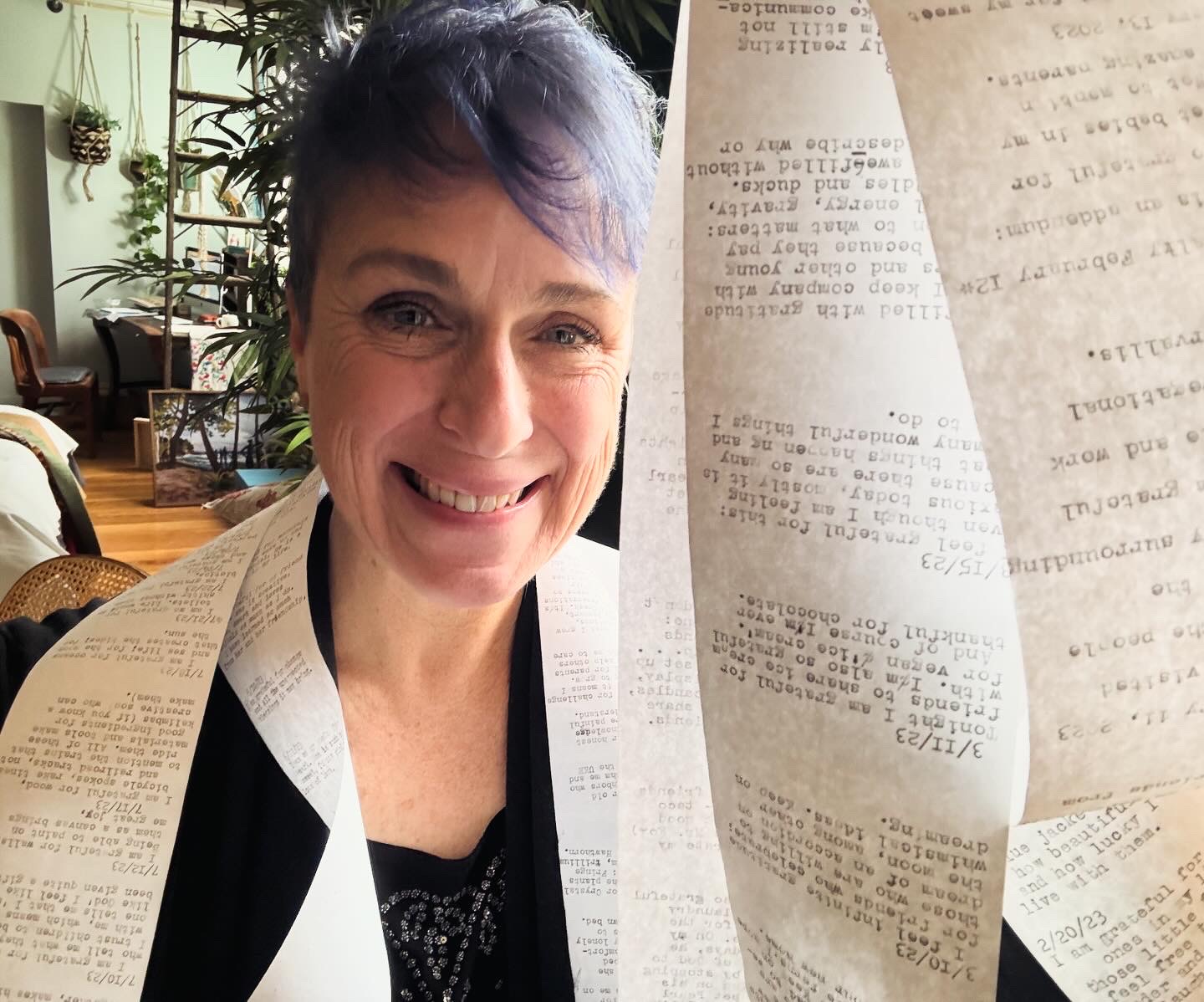
July 1, 2023: I am grateful for the number one, which does not exist on this typewriter. I use the Roman Numeral. Of course this leaves me so grateful that I am able to improvise.
July 4, 2023: I am grateful for friends who understand my sensitivity to sound as well as Pearl’s special sensitivities. This is a challenging day for us and I am grateful for friends who respect us and understand.
July 5, 2023: I am grateful for language. Also, I am grateful for a certain 2 year old who loves language so much that the words cocoon and raccoon, when said together, makes him laugh.
July 10, 2023: I am grateful for children who tell me what they think. I trust children to be real with me, which means when one tells me I smile ‘like God’ I feel like I’ve been given a gift.
July 12, 2023: I am grateful for walls. Being able to paint on them as a canvas brings me great joy.
July 17, 2023: I am grateful for wood, bicycle spokes, rake tines and railroad tracks, not to mention the trains that ride them. All of these materials and tools make good ingredients for kalimbas (if you know a creative soul who knows how to make them).
July 18, 2023: I am grateful for the ocean and sea life; for the moon that creates the tide; for the sun.
July 21, 2023: I am grateful for toilets. Life would be shitty without them.
July 22, 2023: I am grateful for antibiotics.
July 24, 2023: I am grateful for avocados and those who harvest them.
July 25, 2023: I am grateful for perfect, ripe blueberries.
July 26, 2023: I am grateful for rivers and the water that defines them.
July 27, 2023: I am grateful for tea, and Japanese made glass tea pots that allow me to watch the leaves unfurl.
July 31, 2023: I am grateful for fresh figs, ripe and straight out of my friend’s yard to my door. I have never tasted candy so delicious.
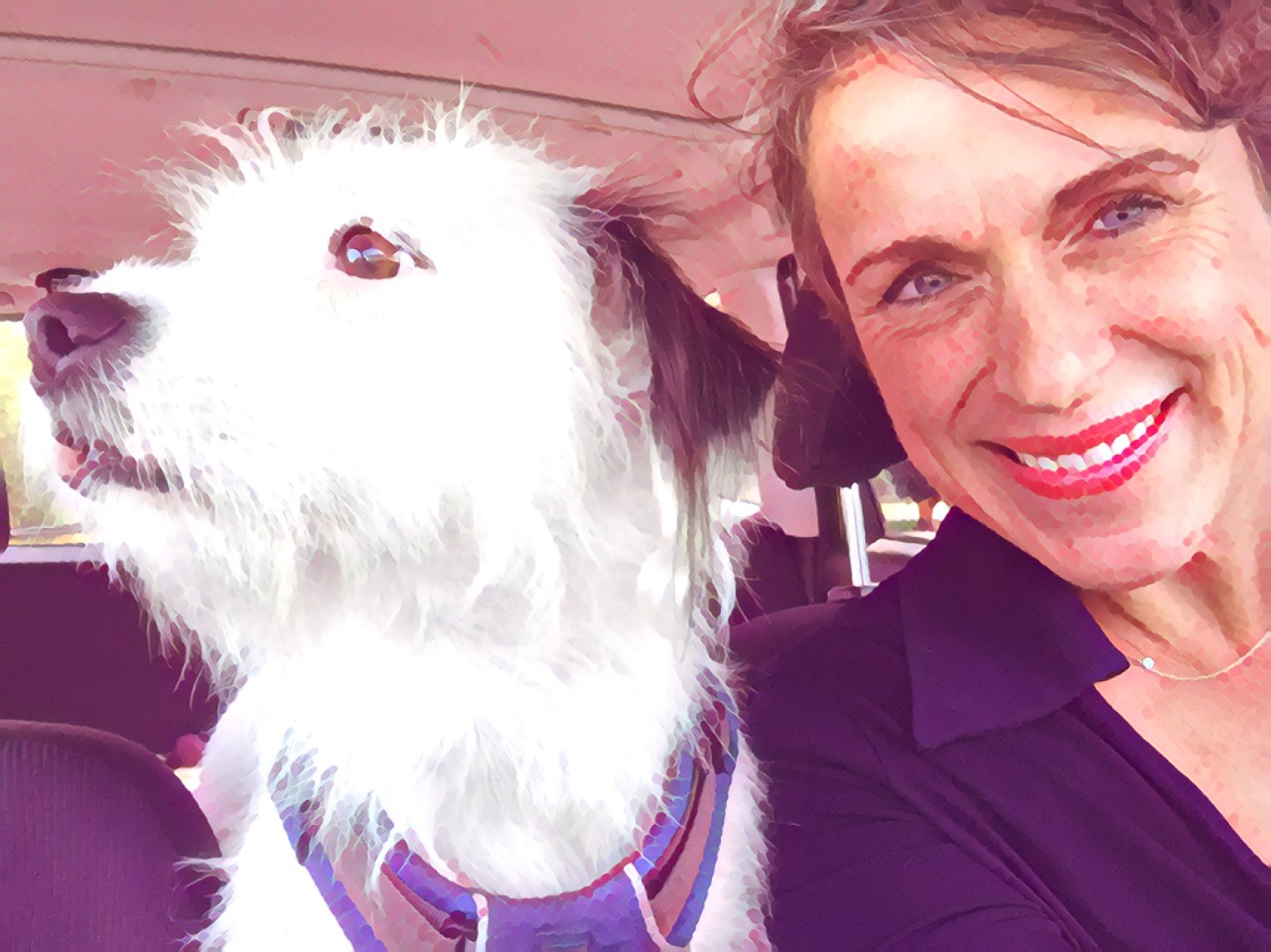
My philosophical quandaries often come from interactions I have (or observe others having) while at the city dog park. This week has left me a feeling unsettled due to two interactions between myself and one man. To begin, I’ll say that the dog park is like my backyard; I live in an apartment and my dog Pearl and I go the three blocks just about every day so that she can say hi to her friends, especially Bob, who gives her treats. Bob is one of Pearl’s first human friends–it only took her about a year to accept him as a friend. For the year prior to this acceptance, Pearl was skeptical and kept her distance because she’s afraid of men.
This week was a rainy one and few people showed up with their dogs at the usual time. While watching Pearl investigate the empty park, I watched as a car parked, a man walked toward the dog park entrance without a dog. I stood near the gate because I know Pearl well. She is not a fan of 1. men, 2. people who come into the park without a dog, and 3. any sort of barrier. On cue, Pearl began barking at the man, who now stood inside the area between the outer and inner gates; the place where, if he’d had a dog, he would be taking off its collar before entering the main park.
The man glared at me. I assured him that Pearl is friendly, she just really hates that barrier and that once he was through the gate, she would be able to relax. What I got back was unexpectedly angry. “It looks like an untrained dog to me.” The man continued to stare at me until I said, “You could use the other entrance.” To which he replied, “Why should I? I have as much of a right to be here as anyone.” Then he walked through the gate and Pearl jumped to his hip. “Get your damned dog off of me.” I corralled Pearl and said, “Dogs pick up on your aggression.” The last thing I heard him say as he touched his thumb and forefinger together, “Dogs brains are this tiny. They don’t know anything.” Steaming, but not wanting to engage any more, I encouraged Pearl to walk to the other end of the dog park with me. As the man returned to his car and entered the street traffic, he slowly passed by while raising a finger in my direction.
Next, on another day, while at a nearby coffee shop with a friend, I watched this very man, with his Service Dog (a Rottweiler) say goodbye to the barista and my thought was, “Oh, he has a service dog, I can see that this dog may be of some help to him.”
Today, while Pearl and I were at the dog park alone two things happened at once: this man parked, got out of his car, and walked his dog to the fence while a regular dog park visitor made his way to the gate with his two large Huskies. Pearl barked at the man and his unfamiliar Rottweiler and I calmed her down and held her as the men took turns entering the park. The man with the Rottweiler said to me, “If you push down on her rump, she won’t do that anymore.” Thanking him for his advice, I walked with Pearl to the other end of the park. Pearl investigated the park with the Huskies while their owner and I chatted. The man with the Rottweiler stood against the fence for about 5 minutes. Then he came towards me and from a distance of about 20 feet said, “I remember you from the other day when your dog jumped on me.” I acknowledged him with eye contact, nodded and thought, ‘okay Jaqui, get ready to be kind and friendly because I think this man is about to acknowledge his responsibility in our first interaction days before.’
Instead, the man stared with flashing eyes, and pointed at me saying, “That day my friend was in the hospital and nearly died.” There was a pause because I didn’t reply, I just watched him. He angrily put the leash on his dog and exited the park. Not wanting to see another raised finger from him, I stood with a tree between the parking area and myself. I comforted Pearl until I was sure the man had driven away.
What I haven’t described (because I’m attempting objectivity) is how angry this man was–it came out of his pores; it was visible. I also haven’t described my physical reaction to our exchange, which was a minor panic attack (throat constricting, heart racing). I knew Pearl would pick up on my demeanor, if not also this man’s angry stance (hence the keeping her close by and comforting her).
So what I’ve been sorting out since this exchange are these questions: Why do people have to share their anger, and why at a dog park? Why do people who think dogs have tiny brains and don’t read human emotion and behavior have dogs? Why do people come in to a dog park and not expect to potentially be jumped upon by dogs? Why was this man so clearly still angry at me for the first interaction? And why does having a friend in the hospital explain poor behavior and anger toward strangers?
Follow up questions I have asked are: Why did I react so strongly? Why did I panic? What am I afraid of? Why did I let a stranger’s anger affect me? Why am I still thinking about all of this? Why do I feel such anger toward this stranger whose friend was recently in the hospital?
What I think is: I have a distaste for conflict, I am fearful that someone like this will entice Pearl to nip them and then turn me in for having a dog that bit a human, I don’t think it’s fair for such anger to be out running rampant and I think people use excuses to explain their anger toward perfect strangers. I’m also feeling upset that I am allowing someone else’s anger to color my entire week.
The truth is also this: I’m weary of attempting to understand everyone else’s reasons for their anger toward me; trying to see things from the other’s point of view; understanding where they are ‘coming from’. I’m feeling weary in this area because I sometimes feel as if others are not making the same attempt to understand or listen to me and my views. It really does come down to not feeling heard, but instead being trampled.
You didn’t mention
these just-ripe blackberries
when you told me about
this tree-lined trail.
Neither the smell of
them warmed by the sun
nor their impossible
color were noted
(a color which can
only be described as:
‘August Mountain Blackberries
In the Shade of Evergreens’).
Maybe these berries
weren’t here when you hiked
this trail; maybe you didn’t
witness their perfect ripeness,
and maybe it’s me
who should be detailing
their succulence to you,
sharing their perfection.
But I can’t just now
I think, rolling another
just-ripe berry into my mouth–
these berries remain
a secret the bears
and I share between us
in the stillness of (and in
fellowship with) these trees.
Written by Violet Case:
“I, Violet Garland Case, was married June 30, 1932 and came to this community as a young bride after graduating from Albany High School which is now occupied by the First Baptist Church of Albany.
“My new husband’s mother died all of a sudden and he had been running the home place prior to this, but now he had no cook and we decided to get married. Now that put an end to my further education. But I did avail myself to some extension type courses, and some classes put on at the Conner School.
“While I was going to high school I had worked part time at Woolworth’s and then after being married, at Montgomery Ward and Company. I enjoyed meeting the public.
“In 1932, they were depression days. I very well remember working for 10 hours a day at 15 cents an hour, training hops for Henry Hoefer Farms and then doing all the work at home in the house. At that time men’s work shirts were 49 cents and peanut butter was sold for 5 or 10 cents a pound and you brought your own container for it. If we wanted ice cream we’d take an empty bucket and get ice cream. We didn’t have fancy containers like today. And if folks got a large peppermint stick from grandparents it was a big treat.
“We grew more diversified crops as years went by. But I always drove a tractor and pulled a combine. We canned pumpkins for Del Monte Canning Company. We also milked a few head of cows each morning and it was my job to wash the cream separator each morning until we started selling whole milk to the Albany Creamery in Albany. Then milk trucks picked up cans daily. I still have some of those milk cans we used.
“I always planted a large garden and canned and pickled all kinds of things. Later we got electricity in this neighborhood and we thought it was the greatest thing. We got milking machines and all kinds of appliances. We could afford them better then as the economy had improved and cannery crops brought more revenue. Back then we’d gotten inside plumbing and what a blessing that was! No more outhouses in the dark.
“We also got to raising baby chicks and had our own fryers to eat. Then we kept the hens and kept a large chicken house and sold eggs from the hens. We got to buying breeding hen turkeys . Our feed supplier would find the turkeys and we would buy them and put them in roosts. We’d string lights which caused them to start laying eggs quicker and we had nests all around in the fields and in the old barn.
“It was real fun picking up turkey eggs. It seems like we got $1 each. We then cleaned them and shipped them away to other states. We did this for several years until the market closed.
“One year high water cam and we had to go out in boats and put turkeys in boats and haul them into the barn to save them. And so thank the Lord they didn’t panic. We hauled them into a dry place. Neighbors were good to help. Walt Harnisch was the good neighbor to help. But in those days people helped one another a lot.
“In 1939 we had a baby boy and named him William L. Case. When he got old enough he started to our country one-room school, Conner School. We always had good teachers because our school was very selective in getting qualified teachers. Mervin Case, Walt Harnisch and others made up the school board. Our son Bill started attending school in Jefferson when he was in 8th grade. Our district consolidated. He had good teachers and the competition in a larger school was good. Bill enjoyed sports and the expanded program of the larger school. We parents got involved in school activities.
“Our grandchildren got a good education background in Jefferson and all 5 of them went to college. The only one that went to a junior college was our oldest grand daughter and she graduated in a medical field to become an employee of Salem Hospital. My family are all pleased with Jefferson and are very involved in many activities.
“For years back I’ve helped with after school time for Bible classes across the street from the school. We used to have Sunday School and church at the Conner School, then later the community acquired an old vacant store building at Dever Station. Then we had church and Sunday School there and used the facility as a community hall for years.
“After a few years the church members decided they needed a church and our men went over to Camp Adair, which was closed down and bought an old theater building (they may have bought more). Men helped tear down the building and it was brought here and first they built a parsonage, then the church out of the used lumber. The folk had a mind to work and there was a peaceful happy atmosphere over all the accomplishments. Women fixed food and pulled nails.
“It’s such a blessing to me today to see the families who had a part in this time. All and all I give thanks for the blessings of living in this farm community, and being married to my dear husband for 68 years before he went home to be with the Lord.”
Written by: Ace Johnson
“One night after football practice it was late, dark, cold and my two buddies and I had no ride. It was 6 miles home, so we started walking. It was fall, we’d had a hard practice and boy! Were we ever hungry! As we walked, we discussed just how hungry we were. About 3 miles down the road was that fruit stand–Mr. Goin always had lots of apples out for sale. When we got to that fruit stand it was pitch black out, but we each felt around until we got a plump apple. We grabbed those apples and took off running down the hill, up the next, down the next hill to Chehulpum Creek. Time to slow down and sink our teeth into those succulent apples. Ugh! Green tomato! We had each grabbed a green tomato. Mr. Goin sold them to people for pickling and canning.
“Later in high school I started dating Mr. Goin’s daughter. Still later, we married. We’ve been married almost 37 years. Sometimes one pays a pretty high price for a green tomato.”
Written for: Danielle Johnson
“There used to be several small community schools in the Jefferson area that were attended by neighborhood children. Most were one or two room school houses with a bell tower. These were gradually closed down in the 1940s and ’50s, but were attended by several of your relatives.
“Not, however, by your great grandfather, Varion Goin, who attended school in Jefferson. He rode his pony to elementary school, stabling it nearby during the day. By the time he was in high school, cars were being seen in the area. Varion’s father Alfred, bought one of the first cars in the neighborhood, but he didn’t like to drive it. So by the time Varion was 15 years old, he was driving the car to school.
“Varion had some health problems that caused him to not attend for a couple of years during high school. He returned and graduated in 1925, I think, where he liked to say he was second in his class. There were only two of them, which was a small graduating class, even for the time.
“Varion’s first three children: Veva, Bonnie, and Vernon, went to elementary at the Looney Butte School which was converted to a house. You probably know which building it is.
“Your grandfather Ace attended a small school south of Salem. If I remember right, it was part of the Salem District, but he lived on the boundary and was able to choose. He went to high school in Jefferson. You’d better ask him to correct my mistakes.
“Jim McManus was raised in Talbot. Local children went to their first three grades (no kindergarten in those days) at Talbot School, a one room school located where the Talbot Fire Station is now. After three years they transferred to a Sydney school for grades 4 through 6. It was located where the Kuzma family now lives. After 6th grade, they rode the bus to Jefferson for the rest of their schooling. By 7th grade, of course, girls and boys were pretty interested in each other (ok, mostly the girls were interested), so the ‘new’ students from Talbot were highly anticipated. They would be known to Jefferson kids and known of by others. There was much checking out of the opposite sex, and of the competition.
“My siblings went to Jefferson Grade School, which is where I expected to go. But it turned out my class was too large for one room, too small for two, so they bused 13 of us to the Conner School every day. Conner took local Dever-Conner students in grades 1-3 but the year I was there, there were only one third grader and three or four second graders. Most of my Jefferson classmates spent a year at the Conner School in first, second or third grade. The school was closed after my third grade.”
Written by: Ace Johnson
“Back in the early 1960s when I went to Jefferson High School, it was common for boys to walk home from ball practice and hitch a ride with most anyone in the community to make the walk shorter.
“Art Brandt drove a manure truck. He hauled and delivered cow manure to and from local dairies around the area. Art’s truck was decorated with cow manure and you could smell it coming well before you could see it. Art was always generous to stop to pick up the boys and give them a ride. It was 6 miles from school to my house, so I never turned the ride down. The only catch was: Art’s dog always rode in the cab with him, so we had to ride in the back on the manure!”

Afraid of life, she listens to
them tell her how different
she is; she takes it to heart
at first. Watch her try, try
try to be like them but
no matter how hard she tries,
she is not like them.
Somewhere along the equation
she realizes that different than
is not less than;
it is equal to. Sometimes (maybe
mostly) different than, plus
different than equals a sum
far greater.
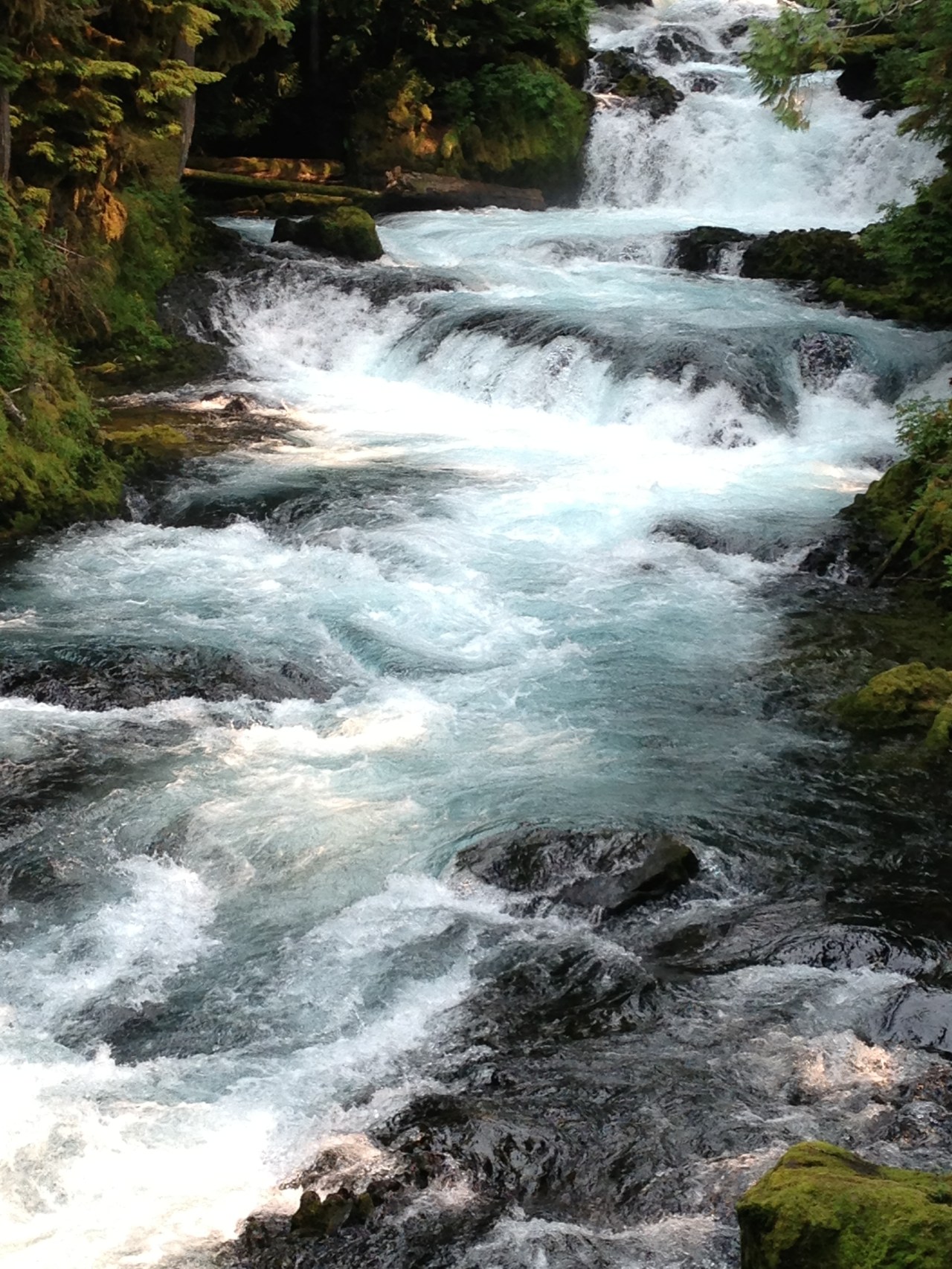
A friend once told me she met
her future husband just after
a turbulent river tossed
her out of her small kayak.
My friend, being who she is, showed
up from beneath the icy water
laughing — her bright smile stretched
across her triumphant face.
The man, knowing his own need,
asked, “who is this woman
that came up from dangerous
water smiling?”
He asked to meet her on dry ground.
They loved well and married,
carried out to the sea of life
by that river-smiling moment.
I wonder how I, being who I am,
could meet another who is able
to come up from the river smiling.
I’m familiar with icy water, dangerous
and turbulent; I watch it carefully,
hopeful to someday see the one
who comes up from the river
with a smile on his face.
 Jaqui Eicher