
Subscribe to continue reading
Subscribe to get access to the rest of this post and other subscriber-only content.
Subscribe to get access to the rest of this post and other subscriber-only content.

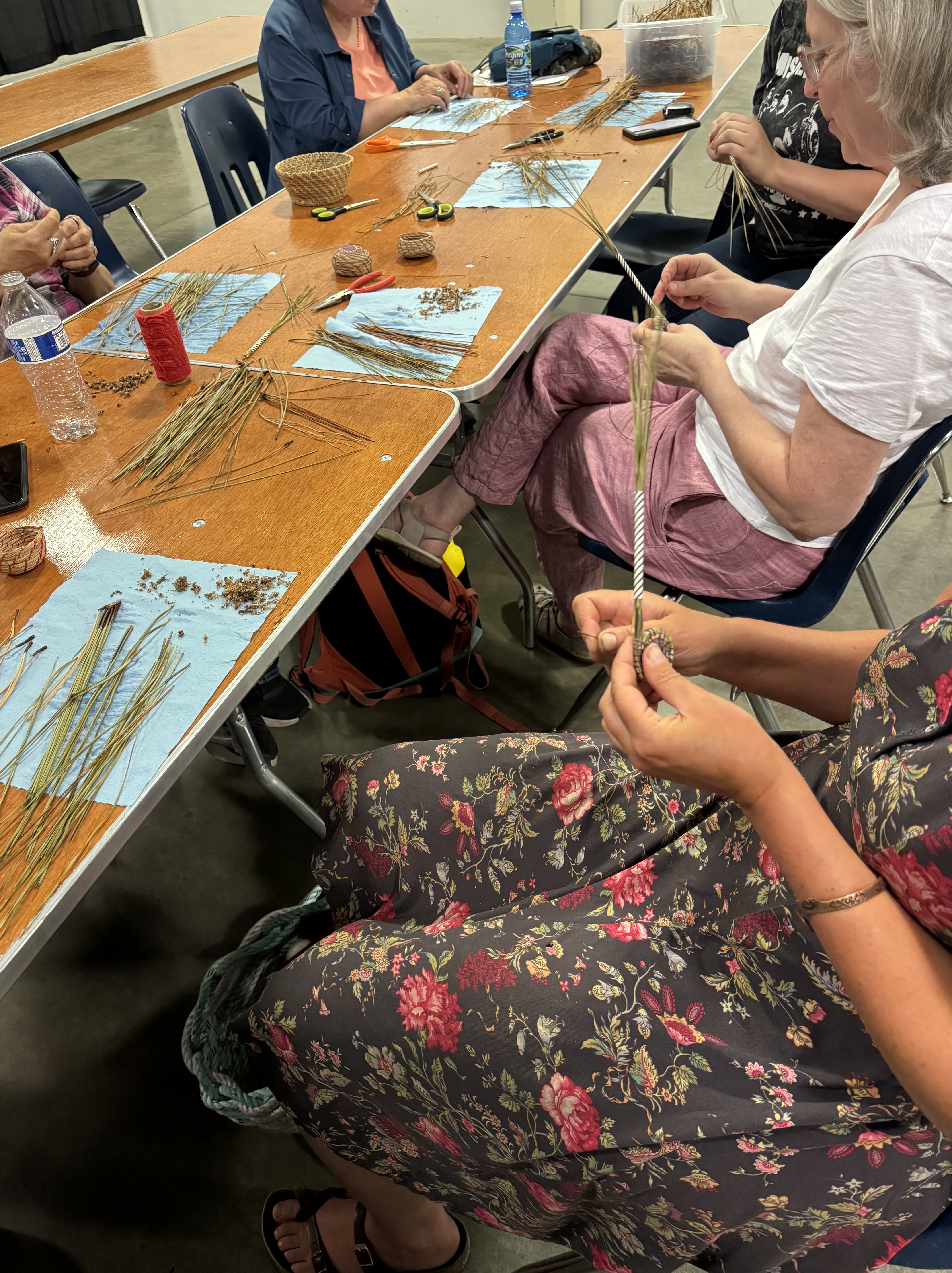
More art in more places. More art at Drift Creek Camp, in the Siuslaw National Forest; more art using gifts from the forest collected on walks with my sweet dog, just minutes from my home. Last week high school age humans created Neurographic art and recycled cardboard bird mobiles and adult humans learned to make pine needle baskets that fit neatly in the palm of their hand. We all paid attention to things that matter, like kindness and empathy and words.
Creating a pine needle basket is an intuitive process. Your hands feel when the bundle of hydrated needles want to start the upward shape of the side of the basket. There is no such thing as a machine-made basket; human hands make them. I noticed, while teaching adults the first simple stitch in basketry, that the word oblique (when offered by a student) to describe what I was demonstrating, felt wildly out of place–but it wasn’t wrong. At the end of the class, we talked about that word and how we all react to words and how we use them differently.
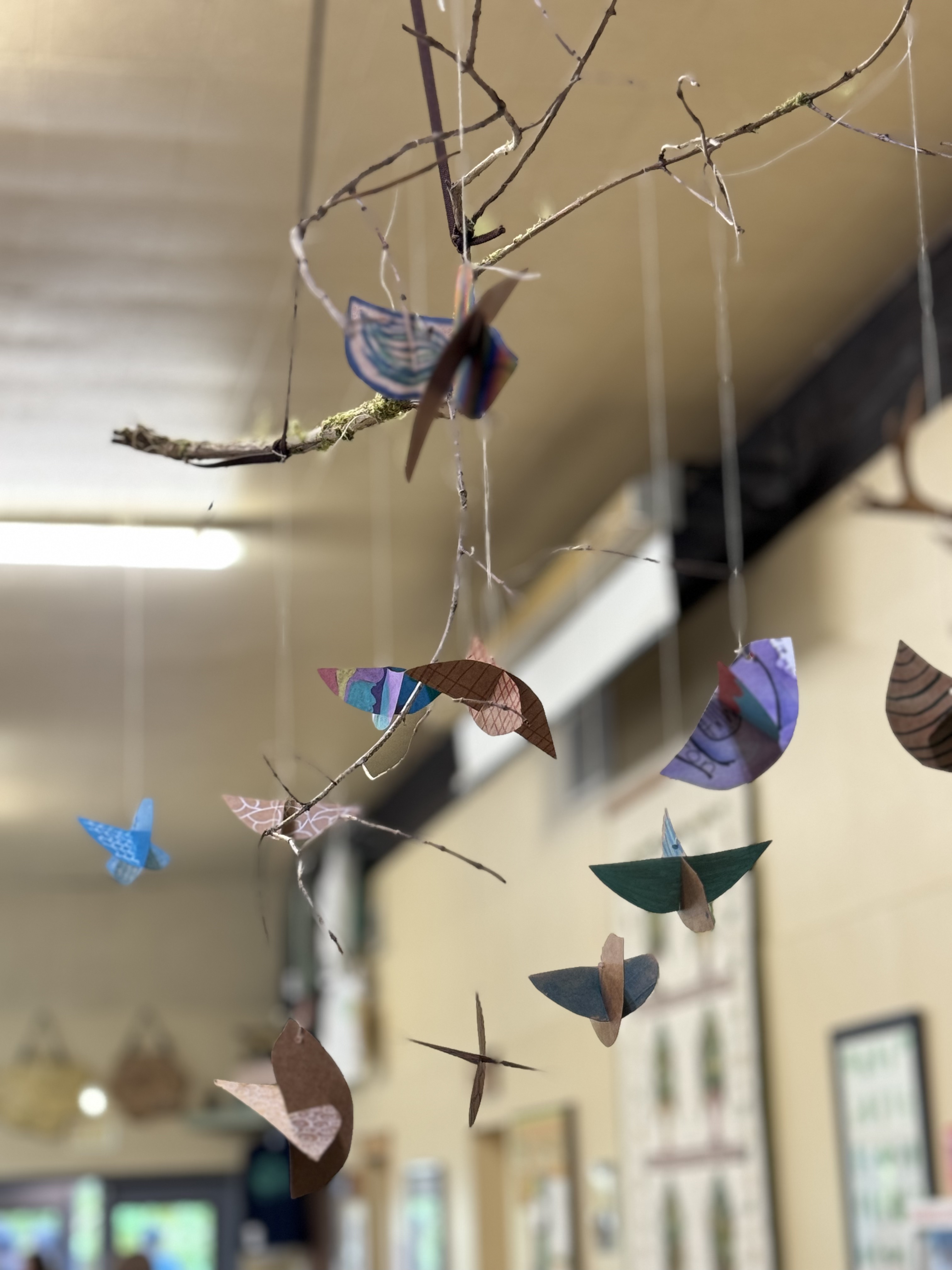
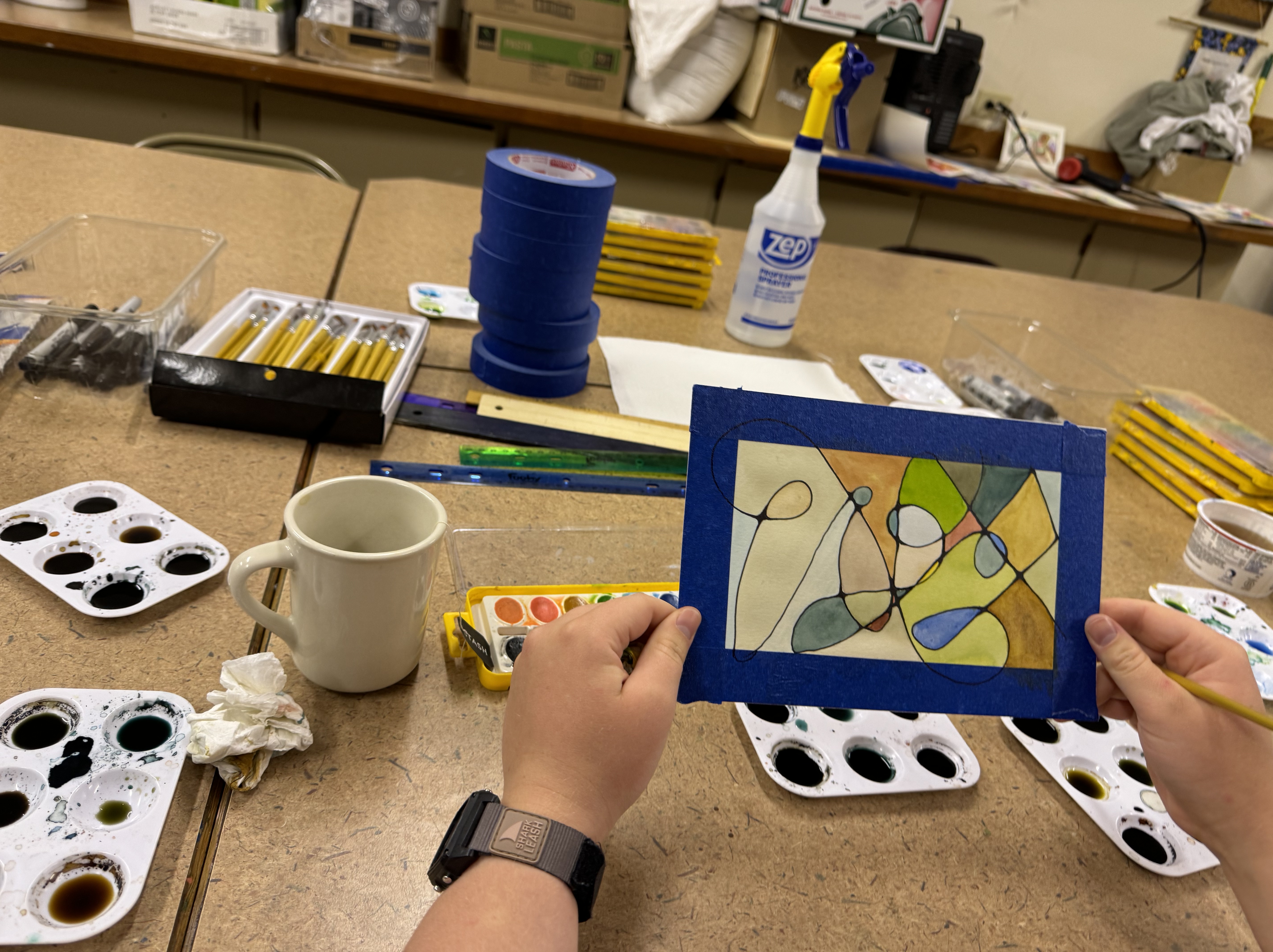
The high school age humans listened as I described the multitude of choices they could make as we progressed through the steps in creating Neurographic art, recognizing that in a world where it feels like they have control of so little, this could feel like a gift. My dear friend Brenda pointed out that using watercolor can also feel like letting go of control (also a gift).
I love this work, and I get tired. After this weekend of another pine needle basket making class at Black Sheep Gathering in Albany, I’m taking a little break from teaching art. I’ll be painting pet portraits instead* while I process all the learning I’ve done this week while I taught.
* I just realized I’m painting a cat named Tommy and a dog named Jerry. That’s fun.
Written by Violet Case:
“I, Violet Garland Case, was married June 30, 1932 and came to this community as a young bride after graduating from Albany High School which is now occupied by the First Baptist Church of Albany.
“My new husband’s mother died all of a sudden and he had been running the home place prior to this, but now he had no cook and we decided to get married. Now that put an end to my further education. But I did avail myself to some extension type courses, and some classes put on at the Conner School.
“While I was going to high school I had worked part time at Woolworth’s and then after being married, at Montgomery Ward and Company. I enjoyed meeting the public.
“In 1932, they were depression days. I very well remember working for 10 hours a day at 15 cents an hour, training hops for Henry Hoefer Farms and then doing all the work at home in the house. At that time men’s work shirts were 49 cents and peanut butter was sold for 5 or 10 cents a pound and you brought your own container for it. If we wanted ice cream we’d take an empty bucket and get ice cream. We didn’t have fancy containers like today. And if folks got a large peppermint stick from grandparents it was a big treat.
“We grew more diversified crops as years went by. But I always drove a tractor and pulled a combine. We canned pumpkins for Del Monte Canning Company. We also milked a few head of cows each morning and it was my job to wash the cream separator each morning until we started selling whole milk to the Albany Creamery in Albany. Then milk trucks picked up cans daily. I still have some of those milk cans we used.
“I always planted a large garden and canned and pickled all kinds of things. Later we got electricity in this neighborhood and we thought it was the greatest thing. We got milking machines and all kinds of appliances. We could afford them better then as the economy had improved and cannery crops brought more revenue. Back then we’d gotten inside plumbing and what a blessing that was! No more outhouses in the dark.
“We also got to raising baby chicks and had our own fryers to eat. Then we kept the hens and kept a large chicken house and sold eggs from the hens. We got to buying breeding hen turkeys . Our feed supplier would find the turkeys and we would buy them and put them in roosts. We’d string lights which caused them to start laying eggs quicker and we had nests all around in the fields and in the old barn.
“It was real fun picking up turkey eggs. It seems like we got $1 each. We then cleaned them and shipped them away to other states. We did this for several years until the market closed.
“One year high water cam and we had to go out in boats and put turkeys in boats and haul them into the barn to save them. And so thank the Lord they didn’t panic. We hauled them into a dry place. Neighbors were good to help. Walt Harnisch was the good neighbor to help. But in those days people helped one another a lot.
“In 1939 we had a baby boy and named him William L. Case. When he got old enough he started to our country one-room school, Conner School. We always had good teachers because our school was very selective in getting qualified teachers. Mervin Case, Walt Harnisch and others made up the school board. Our son Bill started attending school in Jefferson when he was in 8th grade. Our district consolidated. He had good teachers and the competition in a larger school was good. Bill enjoyed sports and the expanded program of the larger school. We parents got involved in school activities.
“Our grandchildren got a good education background in Jefferson and all 5 of them went to college. The only one that went to a junior college was our oldest grand daughter and she graduated in a medical field to become an employee of Salem Hospital. My family are all pleased with Jefferson and are very involved in many activities.
“For years back I’ve helped with after school time for Bible classes across the street from the school. We used to have Sunday School and church at the Conner School, then later the community acquired an old vacant store building at Dever Station. Then we had church and Sunday School there and used the facility as a community hall for years.
“After a few years the church members decided they needed a church and our men went over to Camp Adair, which was closed down and bought an old theater building (they may have bought more). Men helped tear down the building and it was brought here and first they built a parsonage, then the church out of the used lumber. The folk had a mind to work and there was a peaceful happy atmosphere over all the accomplishments. Women fixed food and pulled nails.
“It’s such a blessing to me today to see the families who had a part in this time. All and all I give thanks for the blessings of living in this farm community, and being married to my dear husband for 68 years before he went home to be with the Lord.”
Written by: Marion Pesheck True
“I, Marion Pesheck True, moved to this very house I live in now, in 1937. Four of us kids went to Conner School that fall. Older kids went to high school in Albany and a younger sister was still at home.
“Conner School was a one room school with 30 kids, all grades, and one teacher. I was in 4th grade when I started at Conner School. The school I had gone to in North Dakota taught us to read by sight, not by phonics. So as I listened to the teacher teaching phonics to the first and second grades, I learned them too. That is one good thing about one-room learning. We had a softball team at school and would walk as a group to Dever School about 2 miles away to play their team. I even earned a letter C for my part in the team.
“My family lived 3/4 of a mile from Conner School and we walked in all kinds of weather. We even picked tomatoes (we raised them as a cannery crop) before going to school in the morning and again when we got home from school.
“The one-room school house got too crowded when more kids came to school and another teacher was hired. A curtain was strung across the middle of the school, making 2 rooms; one the lower grades and one the upper grades. The 7th and 8th grades were bused to Albany. The year I went to school in the 7th grade, 1941, they built a 2-room school for 8 grades. So I was an 8th grader in the new school. I was glad to be in the country school that year instead of going to town school.
“In 1942 I graduated from Conner School (8th grade). Also, George Atchison, Verle Lamb, Raymond Gwinnette and Lloyd Lovejoy. My two younger sisters graduated from 8th grade and went to Albany High School. In 1958 my cousin, Carroll Larabee’s daughter Kathy Larrabee Kennedy was to start first grade in Conner school. The school board chose to consolidate Conner School with Jefferson School. So since then this area is in the Jefferson School District. Kathy and her siblings graduated from Jefferson as did Perry Davis, David Harnisch and his sisters, and Bill Case and his sons and daughters.
“Now I am back in the farm house where I lived when my family first moved to Oregon. Perry Davis is still my neighbor as is David Harnisch, Dee Chambers, Bill Case and Lynn Hoefer.
“After the school consolidated with Jefferson, the building was sold and made into a home. It has changed owners several times. The outside is the same, but the inside is very nice and there is an inside stairway to a balcony for a bedroom.
“The tall fir tree that grew in the yard has been cut down before it fell. That was a land mark because it was so old.”
Written by Mrs. Wenger
“Bush School, 1939 – 1945
“I lived south of Salem about where Walling Sand and Gravel Company is located. We rode the school bus. We rode even farther south and up the hill where Morning Side School is. The homes and that hill were mansions, at least to a little girls’ eyes. I remember one girl who lived there. Her name was Norma Paulus.
“Bush School is located on Mission Street. That is for awhile yet. It will be torn down this (2002) year. This is sadness for me. I remember the playground where we climbed in a big tree’s roots, where we played dodgeball. We got so dirty because sometimes the ground was very wet.
“I remember Mr. Beck, our principal. he was a very kind man. I remember my first grade teacher, Miss Dimick. She taught me how to tell time while I waited for the bus to take me home. I remember my fourth grade teacher who believed in ‘good health habits’. she said we should brush out teeth three times a day. she did. Also, every morning we had to raise our hand, handkerchief in hand, to show we carried one.
“I recently went back to Bush School with my daughter and grandson. Ryan wanted a picture of me in front of the school. While we were there I noticed how close to the floor the drinking fountains were. I never noticed that during the years 1939 – 1945.
“This wonderful school that I remember so well was a happy place.”
Written by: Irene Reeves
“My two sons were the fourth generation on their father’s side to attend school in Jefferson — each generation in a different building. When my older son started school in the first grade in September of 1938 the present elementary school was brand new and housed all 12 grades. He graduated from there in 1950.
“The present middle school was built and housed the high school in 1950. Later 7th and 8th graders were housed there as well. I believe the class of 1953 was the first to graduate from there.
“In the early 1970s the present high school was built to meet the needs of an increasing enrollment. During these years the Parrish and Conner Districts consolidated with Jefferson.
“Many of the Jefferson graduates have gone on to college and found lucrative careers in either education or business. Jefferson has some excellent teachers and the success of these students has been a credit to them.
“Jefferson has had much success in athletics as well, as proven by the trophy case. Be proud of your school and do your part to help make it a good school. ”

Afraid of life, she listens to
them tell her how different
she is; she takes it to heart
at first. Watch her try, try
try to be like them but
no matter how hard she tries,
she is not like them.
Somewhere along the equation
she realizes that different than
is not less than;
it is equal to. Sometimes (maybe
mostly) different than, plus
different than equals a sum
far greater.
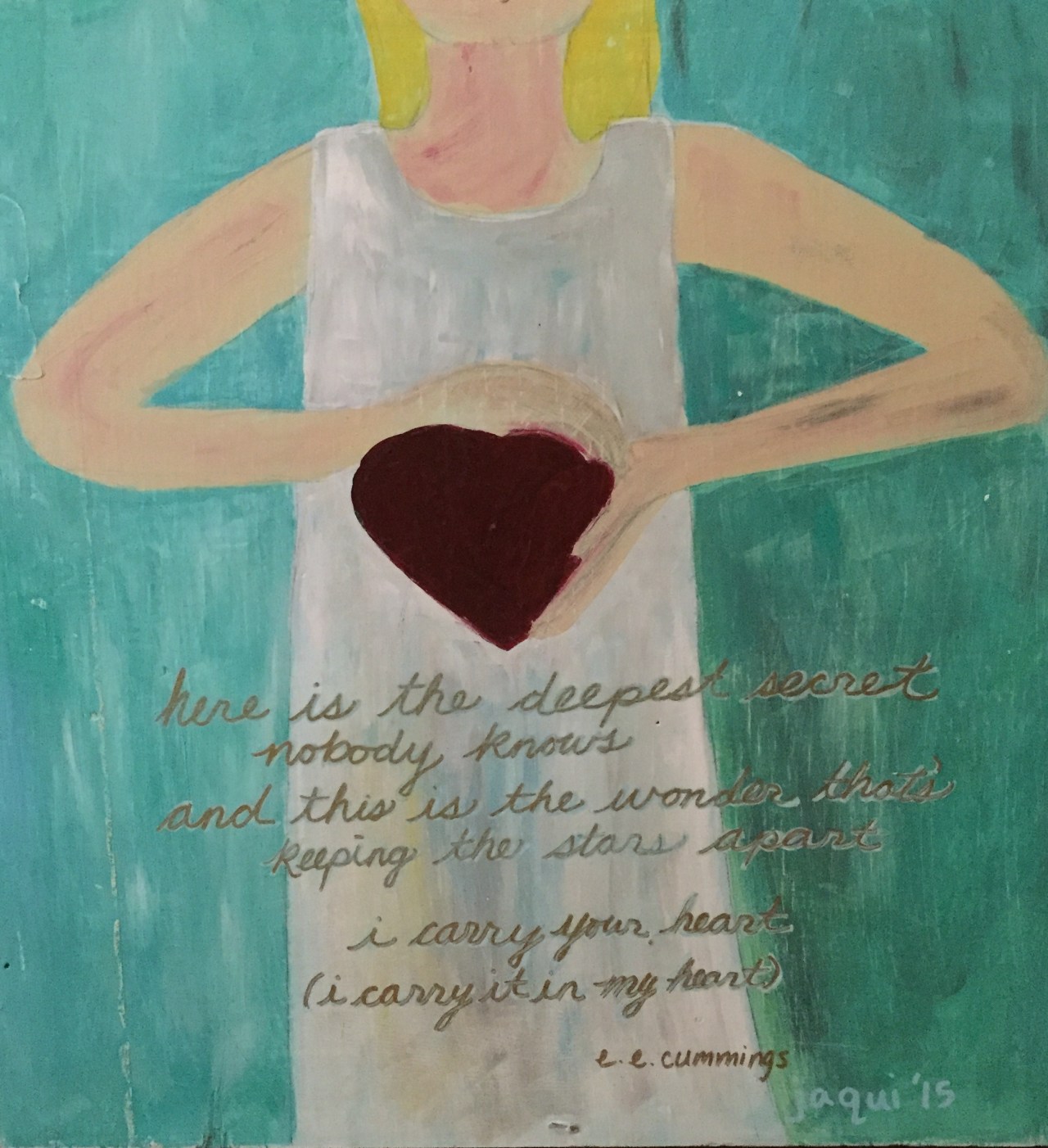
(Written for my art students at Howard Street Charter School, 2012)
The color of your heart is deep and wide–
It gathers all around me
And fills my days with laughter rich
And teaches me to be
More colorful myself, spilling all
My deepest hues
(Those I tend to hide inside)
Instead of showing them, like you.
Together we can paint the world to
Create a masterpiece
Of love and harmony and then
Our world can be at peace.
Conner Community
“My name is Dee Chambers. I moved to the Conner Community with my parents Elmer and Jennie Chambers and two sisters when I was in the fourth grade. We moved into a shack of a house with only one light bulb and no running water. The toilet was out back of the house. The house was a board and bat construction. That is: wide boards were nailed on to the frame vertically and narrower boards were nailed over the cracks between the wide boards. The house was situated in the place where Larry Langmade now lives at the East end of the Dever-Conner overpass. The walk to Conner school every day was about a mile each way.
“My closest friends at that time were the Miller boys who lived North of what is now Higbee Drive. The house they lived in had to be moved when Interstate 5 was built. So Lynn Hoefer purchased it and moved it to its present location where Lynn and Claudia Hoefer still live. In the summer we used to go swimming at the bluff on the Santiam River. More about the bluff later. We only lived here for about a year, then my parents bought a farm in the Jefferson area so we moved to Jefferson. After we were there for about a couple of years, World War II ended and a young fellow (his name is Dale Turnidge) came home from the army and wanted my parents’ farm so they sold it and bought another one back in the Conner community. We moved back there across the road from the Davis family. The Cook family was just down the road a short distance as was the Pesheck family. It was back to Conner School again and it was a mile walk each way. And that’s where I grew up.
“Conner School was a two room school: 4 grades in each room. I graduated from the 8th grade at Conner then went to high school in Albany. I finished high school and started farming. Many years later, when my parents quit farming, I purchased their farm and moved into the house they had built in 1951. Many years later I sold the farm to my son who lives there now with his family.
“When I was going to school at Conner, the school was heated with a wood stove, so the older boys got the job of going to school early and took turns one month at a time to start the fire in the stove. That way the school would be warm when the teacher and the rest of the students got there. We got $5 a month from the school board for this chore.
“A couple of things I remember about growing up in the Conner Community:
“We went swimming at the floating bridge. The Turnidge family had a farm on both sides of the Santiam River on what is now Don Turnidge’s farm in Linn County and Keith Johnston’s farm in Marion County. They build a pontoon bridge across the river. It was just a couple of big logs with boards nailed across it. It was anchored to each bank with heavy cables so that you could drive on it. It was a great place to swim–we had a lot of good times.
“Another thing I remember is the ball games. The community liked to play softball. So much in fact that Albert and Walter Harnisch built a ball diamond for us just South of where Craig and Beth Christopherson now live on a piece of ground that was though to be too rocky to farm. It is now planted to blueberries. The Harnisch men even put up lights for us so we could play in the evening after work.
“Back to the bluff: it’s where the Santiam River and Bluff Road meet. It has always been called The Bluff by everyone in the community. I don’t know this for a fact, but I was told this by some of the old timers who would have known. Many years ago, sometime in the mid 1800s, across from The Bluff, on the Marion County side of the river was Syracuse City. There was a ferry there that hauled people and their goods across the river. This was before there were any dams and flooding was a regular occurrence. One winter a real bad flood happened and washed the town away. The people living there decided that perhaps it was not a good place for a town. So it was not rebuilt. Instead they built a new town up river on higher ground and named it Jefferson.
“Having lived in the Conner community now for almost 60 years I can say it’s been a good place to grow up, live and raise a family. A lot of changes have taken place in the period of time. A lot of people still think of us being out in the country, but the city is getting closer all the time. Why, city water is only three miles from our farm now. It’s certainly not the country I remember as a kid growing up. By the way, I forgot to mention that I am Abby Chamber’s Grandpa. I can’t help but wonder when she is my age and looks back at the Conner community what changes she will see; what memories she will have. I trust they will all be good ones.
–Grandpa Chambers
My First Year in School
“When I was six and in the first grade I went to Jefferson School. It was located where the elementary school is now. The first floor was elementary and the second floor was high school. In the basement were our rest rooms. One noon I was late to leave the rest room. The bell sounded and I couldn’t get the door open because it was stuck or locked. I could not get out. I never came to class so the teacher sent someone to look for me. They couldn’t get the door open either and I was so embarrassed. Two big boys from the upper class came down and took out the window. One jumped in and lifted me up to the other boy outside the window.
“My most embarrassing moment.”
–Louise Looney Cox
 Jaqui Eicher