HERITAGE JOURNALS: STORIES COLLECTED BY 6TH GRADE STUDENTS OF JAQUI EICHER, 2002

Written by: Margie Chrisman Powell

“I was born in Kansas and when I was 2 1/2 years old my mom and dad moved our family (one sister, two brothers and me) to Jefferson, Oregon. We had lived on a small farm that my dad farmed. Jefferson was small then and everyone knew each other.

“I especially remember the bridge that was brand new and so clean that it sparkled. That was in 1934. Jefferson had an onion festival before mint was grown here.

“There was no Interstate 5 so all the traffic came through town. During World War II the troops would ride in their trucks and jeeps through town. We would stand on the sidewalk and wave to them.

“There was a movie theater where the Masonic Lodge is now. It cost 10 cents to get in. There were wooden floors and sometimes when the film came off the roll everyone would stomp on the floor until Mrs. Curl, the owner, would come down the aisle and tell us to stop.

“My mom always took me to pick strawberries and pole beans to buy my school clothes. She never just sent me, but came with me because she liked to pick beans too. When I started first grade in the fall of 1938, the brick building which is now the elementary school was brand new. We were the first class to go all 12 years there. Mr. Pat Beal came as our principal in 1940. We had a great band that played at lots of parades. Our motto was “Not the biggest, but the best.”

“I graduated in May of 1950 and married my sweetheart on June 1950 in the Jefferson Christian Church where we still attend. We have 3 grown children who all graduated from Jefferson High School. We also have 6 grandchildren and 1 great granddaughter.

“I can’t imagine living any place but in Jefferson.”

HERITAGE JOURNALS: STORIES COLLECTED BY 6TH GRADE STUDENTS OF JAQUI EICHER, 2002

Written by: Connie Baillie

“I was born on a hop farm near Amity, Oregon. I went to Wheatland Grade School through the eighth grade and then to Amity High School. After graduating in 1945 I moved to Salem and got a job with the State of Oregon. There I met my husband to be, Charles Kerper who was employed with the State Tax Department. We raised four boys who have presented me with 10 grandchildren. I served as Den Mother for eight years and also as Room Mother. We did a lot of traveling all over the Northern states, back to where Charles was born in Pennsylvania. We also went to Washington D.C., twice to Yellowstone Park and to Disneyland with the boys. Charles passed away in 1972. I went back to the State Revenue Department and worked until 1989, seeing that my boys went to college. I married Glenn Baillie in 1984. We did some traveling to Nebraska, Wisconsin, California, Mexico and Canada.

“When he passed away in January, 2001 I sold my home and moved to The Springs at Sunnyview.”

HERITAGE JOURNALS: STORIES COLLECTED BY 6TH GRADE STUDENTS OF JAQUI EICHER, 2002

Written by Mrs. Wenger

“Bush School, 1939 – 1945

“I lived south of Salem about where Walling Sand and Gravel Company is located. We rode the school bus. We rode even farther south and up the hill where Morning Side School is. The homes and that hill were mansions, at least to a little girls’ eyes. I remember one girl who lived there. Her name was Norma Paulus.

“Bush School is located on Mission Street. That is for awhile yet. It will be torn down this (2002) year. This is sadness for me. I remember the playground where we climbed in a big tree’s roots, where we played dodgeball. We got so dirty because sometimes the ground was very wet.

“I remember Mr. Beck, our principal. he was a very kind man. I remember my first grade teacher, Miss Dimick. She taught me how to tell time while I waited for the bus to take me home. I remember my fourth grade teacher who believed in ‘good health habits’. she said we should brush out teeth three times a day. she did. Also, every morning we had to raise our hand, handkerchief in hand, to show we carried one.

“I recently went back to Bush School with my daughter and grandson. Ryan wanted a picture of me in front of the school. While we were there I noticed how close to the floor the drinking fountains were. I never noticed that during the years 1939 – 1945.

“This wonderful school that I remember so well was a happy place.”

HERITAGE JOURNALS: STORIES COLLECTED BY 6TH GRADE STUDENTS OF JAQUI EICHER, 2002


Written by: Irene Reeves

“My two sons were the fourth generation on their father’s side to attend school in Jefferson — each generation in a different building. When my older son started school in the first grade in September of 1938 the present elementary school was brand new and housed all 12 grades. He graduated from there in 1950.

“The present middle school was built and housed the high school in 1950. Later 7th and 8th graders were housed there as well. I believe the class of 1953 was the first to graduate from there.

“In the early 1970s the present high school was built to meet the needs of an increasing enrollment. During these years the Parrish and Conner Districts consolidated with Jefferson.

“Many of the Jefferson graduates have gone on to college and found lucrative careers in either education or business. Jefferson has some excellent teachers and the success of these students has been a credit to them.

“Jefferson has had much success in athletics as well, as proven by the trophy case. Be proud of your school and do your part to help make it a good school. ”


Algebra

Afraid of life, she listens to

them tell her how different

she is; she takes it to heart

at first. Watch her try, try

try to be like them but

no matter how hard she tries,

she is not like them.

Somewhere along the equation

she realizes that different than

is not less than;

it is equal to. Sometimes (maybe

mostly) different than, plus

different than equals a sum

far greater.

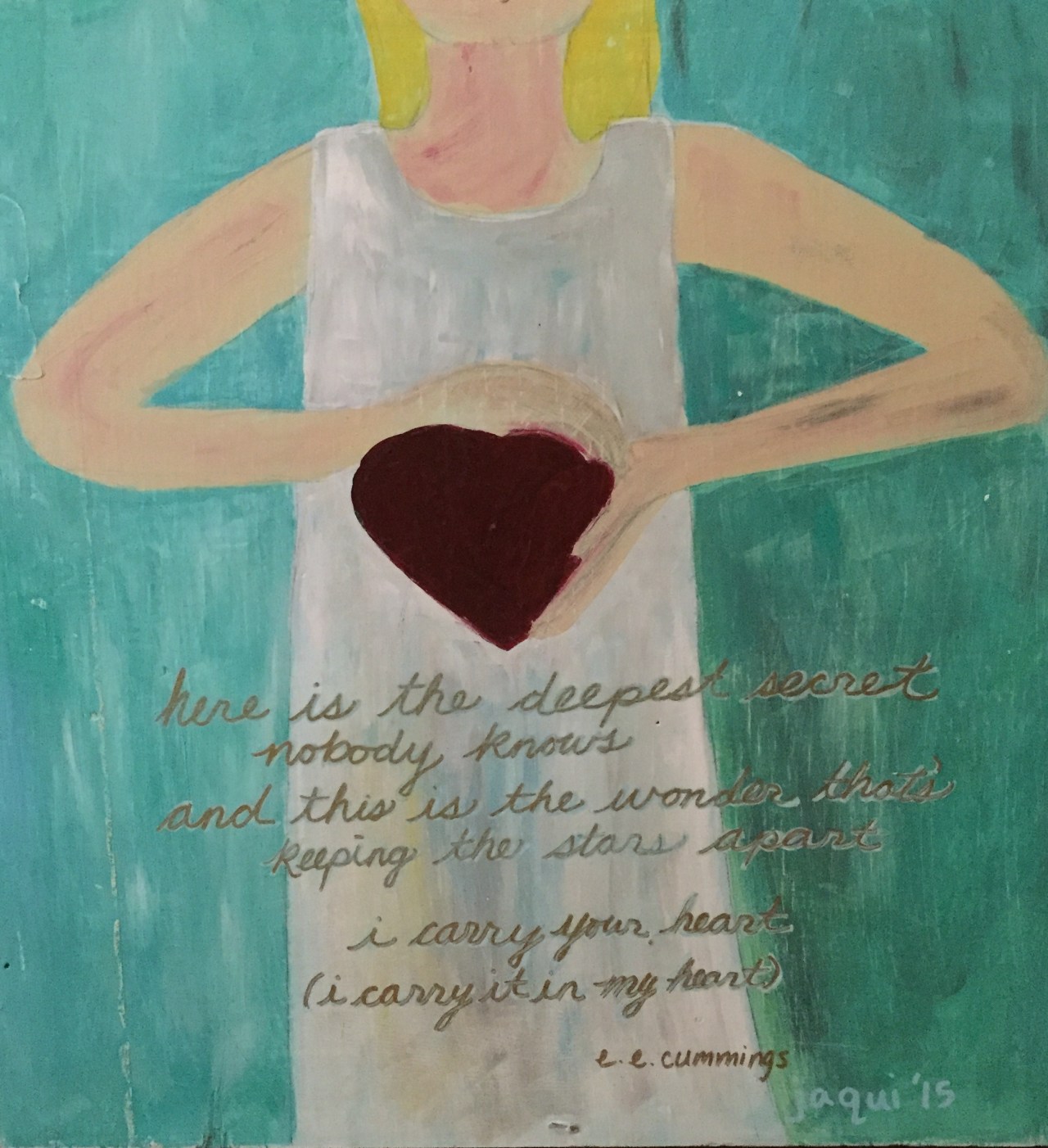
The Color of Your Heart

(Written for my art students at Howard Street Charter School, 2012)

The color of your heart is deep and wide–

It gathers all around me

And fills my days with laughter rich

And teaches me to be

More colorful myself, spilling all

My deepest hues

(Those I tend to hide inside)

Instead of showing them, like you.

Together we can paint the world to

Create a masterpiece

Of love and harmony and then

Our world can be at peace.

No Monsters Here

(a poem written for my students in 2011, after news of a school shooting incident)

Four walls around us protect

Not only from the elements,

But from the ‘Out There’;


In here, there are no monsters;

Hydras, Chimeras, Griffins

and Dragons, STAY OUT!


There is a bubble around

Us–we are safe and sound.

Even if you pound, pound, pound,


We won’t worry because

In this room no monsters

Roam; we shine in this room.

HERITAGE JOURNALS: STORIES COLLECTED BY 6TH GRADE STUDENTS OF JAQUI EICHER, 2002

Oregon Pulp and Paper Company

My father worked for the O.P. and P. (Oregon Pulp and Paper Company) for 30 years. He started out as a boiler man, feeding the furnace. Then he worked up to the Bleaching Department. They wanted him to be the supervisor but he never accepted the job.

One day he gave me and my sister a tour of the plant. We saw how the wood came into the mill and was mashed into a pulp, which was wood and water. Then the water was squeezed out. It was sent to the bleaching vats where bleach was added. It was mixed with huge paddles and then sent to another machine. It was sent through this machine, a huge press that pressed out all the liquid and then to giant rollers that rolled it flat, finally in paper that came out in huge rolls. Some of the paper was dyed different colors.

The building+ is still located on Trade and Commercial Streets in Salem, but it’s called Boise Cascade. While talking to a lady in the office the other day, she told me that soon the name would change to just Boise. It still is in the paper business but I am sure it is very modernized by now.

–Mrs. Wenger

+ This building has been turned into downtown condominiums and shops, 2016

HERITAGE JOURNALS: STORIES COLLECTED BY 6TH GRADE STUDENTS OF JAQUI EICHER, 2002

The Old Sawmill

There used to be an old sawmill on our property on Rodgers Mountain. The mill was complete with a flume that ran down the mountain and into Scio, a mill pond, sawdust pile and wood cutter’s cabins nearby. We have an old picture of the mill, taken when it was still operational. Our family and the Scio Youth Art Class painted a mural of the sawmill, with original equipment, to show the difference between now and then. To this day, we still find old gears and cable on our land. Our dad, when he was a child, and Grandpa even found an old tractor and got it to work.

–Joel A. Lonbeck

Rodgers Mountain Loop, Scio

HERITAGE JOURNALS: STORIES COLLECTED BY 6TH GRADE STUDENTS OF JAQUI EICHER, 2002

Jefferson Then

My family moved to Jefferson in the Spring of 1946 from Southern California following World War II. My father worked in the shipyards and my mother ran a boarding house there.

We came to Oregon so the family could work in the fields which we did, starting with strawberry picking, mint hauling, bean picking, corn picking, etc as all were done by and before mechanization of those crops. There was no minimum age limits, so we all could work, and did all summer. We were all responsible for making enough for all school clothes and expenses. When we came to Jefferson, there seemed to be a lot more business than today.

Downtown had a Confectionary where we could go for ice cream, milk shakes, etc. There was a drug store, Doctor, Theater, two active lodges (Masons, Eastern Star Oddfellows and Rebeccas), a blacksmith, variety store, several grocery stores, several service stations and cafes, just to name the first part of the business area.

The “Terminal” was on the highway (Second Street) and was the bus terminal as Greyhound busses came through regularly. This was prior to the construction of Interstate 5 and highway 99 was the main north/south highway going through Jefferson.

Having been born on the Texas Plains and raised in Southern California among the Palm Trees, the thing that amazed me most was how high the fir trees grew! And I never knew that mint was a farm crop.

I have lived in Jefferson now for 57 years, married a Jefferson born native, raised a family, worked and retired in Jefferson and have see many, many changes take place in town. Major businesses destroyed by fire include the Evangelical Church, the Mari-Linn Co-Op and Freres Lumber Company, each of which have been replaced except the Co-Op.

A bank came to Jefferson in 1963, a new post office in 1960 and again in the early 1990s.

In 1946 there was one school that included all 12 grades. Now there are three schools as the population has grown to require a grade school, middle school and high school. Jefferson will continue to change.

–Margaret Hire Knight