Joy!

When I was young, Christmas was a time for ‘dressing up’ in my family. We wore our ‘good’ clothes to church and to special Christmas events. I loved the feeling of joy that surrounded these opportunities. My mom created a sense of joy in our home by decorating and inviting my sisters and I to help in the decorating. I have fond memories of getting the boxes out of the attic, unpacking them, and then spreading the garlands, bows and tinsel all around the house. We had a few different nativity scenes to put in different rooms too. Once we had the tree up, unpacking all the beloved ornaments was an activity all its own. Still today, as I talk about this, I feel the joy of the season coming through me.

I grew up on a beef feedlot just a few miles from here, on Eicher Road. By this time of year, my parents were finalizing plans for creating more than 100 ‘meat packages’ to distribute to friends and neighbors. This meant that my sisters, brothers, and I would gather around the kitchen table, wrapping sausage and chipped beef in freezer paper, then in red cellophane. We would add a bow, and place some of each type of meat into a basket. These special packages would be loaded into the car and off we’d go to deliver them over the next handful of days leading up to Christmas.

It was a special thing to grow up this way—with a sense of generosity and abundance to be shared with others. I loved being part of this joyful sharing. Some neighbors on Eicher Road have lived there more than 50 years and I know they received that many Eicher Christmas Meat packages. The most beautiful part of this is what happened next—neighbors would appear at our house with packages of all kinds of treats! Cookies of every sort, including Donna Rietz’s famous chocolate covered peanut butter balls! Our kitchen counter held plates and baskets of homemade treats!

I bring all of this into this message for the third week of Advent because we celebrate the Joy of Jesus’ birth, and the Joy of Jesus’ life and message: Share with others, help each other, ALL ARE WELCOME. In the scripture reading from Isaiah we hear the words, “The year of the Lord’s favor” which might ring a bell for some of you. It’s a reference to the ‘year of jubilee’.

Jubilee was historically a time when everything was set back to its starting place and I think there is something so beautiful about this idea. It seems like a relief to know that things can return to they way they started, rather than just getting worse and worse, or more and more confusing.

I am a nanny for a little boy named Nathaniel, who is 3 years old. He loves to play with his wooden train tracks and we often build entire worlds when we are together. It’s always different. He usually doesn’t want to put the wooden train set away, to preserve this world he built. But his mom has taught him that at the end of each day, the house will be ‘re-set’ to it’s ‘put-away’ state, and tomorrow everything will start afresh. Nathaniel has learned that this is a helpful way to go about building his train worlds because with each new day, he remembers how to build the parts he really liked about his previous world but can forget about the parts he didn’t care for, or that weren’t as he wanted them to be. In this way, he is exponentially growing and learning.

Another personal connection to this idea is from my one-day lesson in welding from a master welder. There is more to this story, but the part I bring to share today is this: As I learned to hold the tool and create a ‘bead’ of weld along the joint line, this teacher told me that if I got too shaky or the line got too wobbly, I should stop (rather than keep going). In other words, take a moment to pause and refocus my attention to creating a clean line. That lesson has proven so helpful in my non-welding life.

Two weeks ago Rob in maintenance here at MV told me a wonderful story that I want to pass on to you. I wanted to bring it into the first week of Advent as a story about Hope, but I think it fits during this week of Advent just as well, and it resonates with this idea of ‘year of jubilee’. On a walk near his property, Rob heard an interesting sound coming from a pipe near the ground. After further inspection, he found it came from a tiny kitten deep inside the pipe and even after urging the kitten to come out, it resisted and was scared. Rob spent 20 minutes trying to coax it out and made a tiny lasso which he finally managed to hook around the tiny kitten’s arm. Gently he pulled the kitten out. Covered in oily sludge, Rob wrapped it up and brought it home. And found a great home for him, where he lives and plays with a big German Shepherd dog friend. Imagine the joy!

These stories illustrate, at least to me (and I hope to you), that there is restoration in Christ’s birth and life. There is restoration in righting things in the world that have become out of alignment. The world can be restored to its starting position if we follow Jesus and there is JOY in this because people (and kittens) who don’t have what they need will be given enough; people on the fringes or margins will be included into the mainstream or ‘whole cloth’.

It doesn’t matter who you are or what you have or haven’t done in your life. It doesn’t matter whether you live in a house/tent/apartment/tiny home/mobile home/or the Mennonite Village. It doesn’t matter whether you experience illness or immobility. It doesn’t matter who you are. ALL ARE WELCOME to be surrounded by the Hope/Peace/Joy of Jesus and welcomed into the house of God.‘The Jesus way is to come together with those who are on the fringes, the marginalized, who are present within and outside of our community.’ As followers of Jesus we can seek out those who are marginalized, or on the fringes of our society. We can light the way for others by sharing joy.

AND, as followers of Jesus, when we are not experiencing this joy, we can join with others who are. We can soak up the joy of others around us, and in this way ‘water the seeds of joy’ in us. Sometimes, if you are like me, you can feel guilty for not resonating with the joy of the season. Remember, ALL ARE WELCOME. Joy is here for all of us whenever we are ready for it.
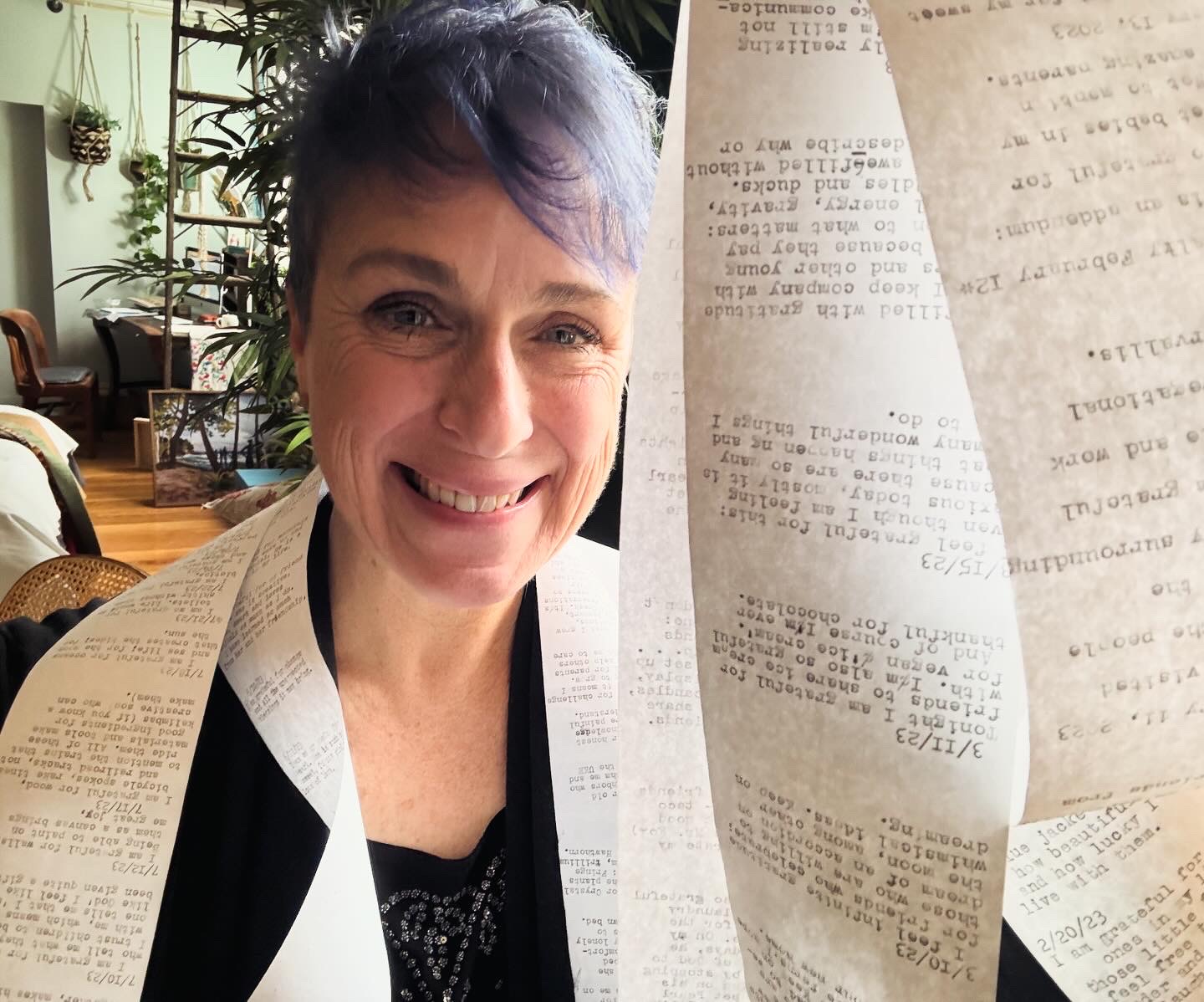
My Type of Gratitude List, No. 6

July 1, 2023: I am grateful for the number one, which does not exist on this typewriter. I use the Roman Numeral. Of course this leaves me so grateful that I am able to improvise.

July 4, 2023: I am grateful for friends who understand my sensitivity to sound as well as Pearl’s special sensitivities. This is a challenging day for us and I am grateful for friends who respect us and understand.

July 5, 2023: I am grateful for language. Also, I am grateful for a certain 2 year old who loves language so much that the words cocoon and raccoon, when said together, makes him laugh.

July 10, 2023: I am grateful for children who tell me what they think. I trust children to be real with me, which means when one tells me I smile ‘like God’ I feel like I’ve been given a gift.

July 12, 2023: I am grateful for walls. Being able to paint on them as a canvas brings me great joy.

July 17, 2023: I am grateful for wood, bicycle spokes, rake tines and railroad tracks, not to mention the trains that ride them. All of these materials and tools make good ingredients for kalimbas (if you know a creative soul who knows how to make them).

July 18, 2023: I am grateful for the ocean and sea life; for the moon that creates the tide; for the sun.

July 21, 2023: I am grateful for toilets. Life would be shitty without them.

July 22, 2023: I am grateful for antibiotics.

July 24, 2023: I am grateful for avocados and those who harvest them.

July 25, 2023: I am grateful for perfect, ripe blueberries.

July 26, 2023: I am grateful for rivers and the water that defines them.

July 27, 2023: I am grateful for tea, and Japanese made glass tea pots that allow me to watch the leaves unfurl.

July 31, 2023: I am grateful for fresh figs, ripe and straight out of my friend’s yard to my door. I have never tasted candy so delicious.

My Type of Gratitude List, No. 5

June 2, 2023: I am grateful that I can walk out my door and find friends to walk with at lunch time. I am also grateful for friends who ‘feed’ me names of other writers like A.R. Ammons and John Steinbeck to learn from. Steinbeck I knew, but never read. Ammons I never knew, but will as soon as I acquire his book, Tape, which was originally written on a roll of adding machine tape, just like this.

June 7, 2023: I am grateful for mornings that I get to wake up and visit Nathaniel. He is a bright spot in my life.

June 8, 2023: I am grateful for my friend Sara — she is creative, kind, smart and loves animals as much as I do. I have learned a lot from her and the friendship we share.

June 10, 2023: I am grateful for change and all the unexpected blessings it may bring.

June 11, 2023: I am grateful for Pearl. She is such a sweet, fuzzy girl with lots of love.

June 12, 2023: I am grateful for my friend Wolfgang who is one of the most kind and considerate people I know.

June 14, 2023: I am grateful for this typewriter — I enjoy using it to record gratitude. Muscle memory lets me remember good days at Western Mennonite School, like using my watch to reflect sunlight toward John Fillmore.

June 15, 2023: I am grateful for fresh peas from the garden, with lemon, ginger and garlic. I am also grateful for the friends who serve them in a cast iron skillet.

June 19, 2023: I am grateful for cool summer mornings. Pearl and I get to walk in a quiet city, before traffic begins to intensify. She sniffs, I watch store deliveries. I am also grateful for Juneteenth. I am inspired by the strength of my black and brown American friends.

June 21, 2023: I am grateful for good memories of growing up on Eicher Road — playing in the creek, picking mint for iced tea, eating summer sausage sandwiches with Dad in the field he was baling that day. Grandma’s house was only a hop, skip and jump away. I loved her house.

June 25, 2023: I am grateful for water color art. Looking at it makes me feel somehow refreshed.

June 26, 2023: I am grateful for garbage service workers who take what we’ve thrown out, allowing us to distance ourselves from our own messes. Also, these important workers could have their hands crushed in the machines they work with. . . like today. May your hand heal swiftly.

HERITAGE JOURNALS: STORIES COLLECTED BY 6TH GRADE STUDENTS OF JAQUI EICHER, 2002

Written by: Wayne Chambers

“These history talk about Dever School District were given at the 100th year celebration on November 5, 1954 at Dever School. The 8 Edward A. Chambers children including your great-great grandfather Elmer and my father Elbert attended Dever School. My sister Marilyn, brother David and I went 8 years to grade school at Dever.

“The Dever community has changed over the years, resulting in too few students for a grade school. The school building was sold in 1983. I hope this history is of interest to you.”

‘The Beginning of School District No. 20, Linn County

My talk given tonight concerns the years 1854 to 1880, the beginning of School District 20, Linn County. Our toastmistress, Mrs. Harnisch, has already mentioned that Syracuse Precinct had earlier schools, one of which was attended by Allie, McClain, and aunt of Mrs. Elizabeth Truax in 1848. It was located on Fenn Butte, afterwards called Zimmerman’s Hill, where Mr. and Mrs. Parker now live. Mrs. Truax has established this as correct, as there is a spring above the house from which Johnny Fenn, the teacher, carried a bucket of water for his school in the Fenn house. There was also a brickyard close by — a pile of brick is still there. In 1865 the minutes mention this brickyard location. This was the first school in Linn County.

There was a District 22 organized by law in November 1854, from which date we celebrate this Centennial. That schoolhouse was situated on the Charlie Cox farm, once part of the donation land claim of an old pioneer, John Weis, who lived where Mr. and Mrs. Drager now live. This school house was a log house with homemade seats and desks. Quills were used as pens and their ink was homemade. The equipment was a stove with pipe, a bucket, wash pan, dipper and dictionary.

The first directors elected were James F. Jones, John T. Crooks and John B. Miller; the clerk was Benjamin F. Redman who was the first teacher. He was also a justice of the peace. Redman lived in a house east of Ardle Edwards’ old house and was clerk and teacher until 1861.

Much honor is due these early pioneers for their perseverance and ability. We are justly proud of them. The first funds received were $52 in April, 1855. Mr. Redman taught in 1855 three months for $33.33 and received part pay of 58. At that time 3 months a year was the time taught. 

When this district was organized, the pioneers built their own school house by subscription, 17.5 square feet, located very nearly in the center of that district. The pioneers built this log school house in one month’s time. 

In 1858 the voters made a union of District 20 with District 22 and thereafter the entire district was called District 20. By this, we see there was a District number 20 already existing. The Weis school house was then sold to Mr. Weis for the sum of $100, with the teacher taking $65 of his money in trade. Perhaps Mr. Weis ad a store at his place. The remainder of the $100 was paid by James F. Jones. District 22 is now near Scio.

From 1858 to 1869 there was a school house on the Allphin claim near the Allphin cemetery which was on the hill behind Mr. Mervin Case’s house. This was a small school house, too small for the number of pupils attending. At different times it was voted upon to divide the district but the motions were lost as were also motions to raise school money by taxation. This old Allphin school house was sold later to Wm. Allphin for $16 when the new Allphin school house was built.

In 1859 the voters began to talk of a new school house and selected a place as near the center of the district as the nature of the ground would permit but it was not until 1868 that the district accepted a site which Wm. Allphin came forward and proposed to give: a site of 2 acres near Fenn’s Butte on the south side of Allphin’s land claim, near the old brickyard. Dayton Simison was appointed to circulate a subscription list to procure money to build the school house, which he did, and raised $558.  In 1869 the new school house was built. It was 36 feet long, 24 feet wide and 12 feet to the eaves. This was the second school house to be called the Allphin School House. In 1879 it was voted to move this Allphin School House  and the move was made in 1885 to the S.T. Jones Place where Mr. and Mrs. Craft live, which is now the E.A. Chambers’ farm. It was then known as the Syracuse School House, and referred to as the Jones School House. This building burned in the summer of 1911. 

To go back to the pioneers of these years to whom we owe so much, we will mention some of the directors of District 20. They were Samuel T. Jones, John McCoy, Absolam Addington, J.J. Davis, John Meeker, Hiram Farlow, James Butcher, Thomas Allphin, John Weis, Elias Johnson, Christopher Farlow, Henry Johnson, John Wilson (for whom Wilson Lake is named), Wm. Hale and David Lewis. Many of these names we recognized by having heard them mentioned by our parents; also some descendants are living in the districts of Dever and Conner. I will mention these descendants now: Mrs. Myrtle Jones Graham and Charles Jones, descendants of S. T. Jones; Mrs. Zelma Davis Harnisch and Mrs. Davis Harnisch, descendants of J.J. Davix; Stacey Meeker Neeley, descendant of John Meeker; Elizabeth Cardwell Truax and Gerald Truax, descendants of E.C. McClain; Rebecca Crooks Hoefer, descendant of John T. Crooks; Dale Wills Harnisch, descendant of Dayton Simison. 

The clerks who served between 1854 to 1880 are also recognized as outstanding men. Their minutes in the record book clearly show their ability. These clerks we honor this night of November 5, 1954 are: Benjamin F. Redman, who served 7 years; E.C. McClain, 1 year; J.J. Davis, 2 years; Horace Farwell, 4 years; Dayton Simison, 7 years. Samuel Crooks, 4 years (elected in 1876). 

Now to honor our teachers. I will mention just a few of the most important: Benjamin F. Redman, the first teacher who taught 4 years; Lydia Miller, 1/2 year; W.L. Coon of Peoria, 3 months; L. Flynn, later an Albany banker, 3 months; J.D. Pruitt of French Prairie near Salem, 3 months; John S. Fenn, 3 months in 1869, 1872, 1873 and 2 terms in 1874; Peter A. Moses, 3 months in 1879; and T. Handord, 3 months in 1880. 

I know this District 200 was a typical frontier district, having their trials, such as lack of money, no roads, great distances to travel, which was done by horseback, and no conveniences. But they had their joys too. They had singing lessons, political rallies and church services. 

We do not know many exciting events of this period but we are told of two murders, two suicides and a big flood — the water being higher that at any time since, measuring 36 feet in Albany in 1861. I thank you for your kind attention. (Rebecca Crooks Hoefer)


HERITAGE JOURNALS: STORIES COLLECTED BY 6TH GRADE STUDENTS OF JAQUI EICHER, 2002

Written by: Lynn and Claudia Hoefer

“Arriving in the Dever Conner Community on June 3, 1926, the day of my birth, I was just in time to grow up in the Great Depression of 1929. A trip to Albany down an old gravel country road in the Model T Ford car without a top was seldom and an ice cream cone was a real treat. Coming home by Bob Groshong’s house was steep drop off in the road, not a gradual grade as it is now, and my father would try to slow the Model T down with one foot on the brake pedal and one foot on the reverse pedal and would would still gain speed down the hill.

“There are many memories of my early days in Dever Conner such as fishing in Wilson Lake, riding on my father’s old horse-drawn water tanker on a hot afternoon down to Blackdog Landing where river boats landed and brought and loaded much of the things needed in the community. Blackdog Landing reportedly got its name from an old black dog that would lay in the landing and greet the boats when they came in. The tanker was to haul water for spraying pesticides on my father’s hop field and we had to run a pump by hand with a 4 foot wooden handle which we pushed back and forth for about an hour to fill the tanker. Going back to the farm, we would stop in the shade of an old plum tree and let the horses rest while we had our fill of plums.

“I attended Dever School which was heated by a very large wood stove, kept full of wood by one of the boys. This was a privileged job as it broke the monotony of school each time it needed fuel. There was usually only one teacher in the two-room school and 25-30 students in 8 grades and several subjects: recitation, spelling, flash cards. The teacher did it all, and even had time to read for 10 minutes or some other interesting book, which we all looked forward to. Our teacher was also the chief disciplinarian and I remember well one young lady who on more than one occasion would test the teacher’s patience and authority with argument and stubborn rebellion until she would be forced to stay in at noon recess to continue her punishment. Being boys with inquisitive tendencies, the four of us would go around to the back of the school building to an opening in the foundation and crawl there to the underside of the room to listen in order to find out whether she’d give in before she received a good licking. We’d emerge dusty and dirty, brushing our clothes off. I don’t know if the teacher ever got wise to use or not.

“There were only gravel roads then with potholes and muddy water. Walking to school my first two years, later riding a bicycle, was how we got to school, rain or shine. Going was easier than coming home as we were riding into the wind and rain, standing on first one pedal and then the other, barely moving, sometimes even having to get off and push our bikes.

“I never attended school at Conner School. The land was donated by the Conners (relatives of my father) but we had many pie socials and Sunday School meetings in both the Conner School and the Old Dever Store. Sometimes things would get very interesting when some of the older men at the pie-socials would bid some girlfriend’s pie up high, causing much laughter and embarrassment. My mother always taught Sunday School in these old buildings, which were no doubt the forerunners of Dever Conner Church, as we know it now.

“Occasionally the boys who had to devise their own entertainment would gather in our old hop dryers, with its many ramps and catwalks, gather up corn cobs left from the corn shelling (or snow when it would happen to come around) and a real fight would ensue. Sometimes boys several years our seniors would join in and this was alright until they would decide to soak the cobs in water. Corn cobs (and snowballs) soaked in water are murder if you get hit and things would get really rough till everyone was too tired or smashed to continue. Girls were not excluded but I can’t remember of more than one or two joining in.

“Evenings were long and cold in winter: playing checkers or listening to an old Victrola with a Kerosene lamp for light in front of an old fireplace for heat (neither of which adequately served their purpose unless you were up really close.

“Among other memories was sitting between my father’s knees on an old tracklayer tractor, learning to drive down the long rows of hops or sitting with my grandmother on our front porch on a late, hot summer evening, watching sparrow hawks flutter and make their long power dive with an airplane-like sound.

“We had an old horse-drawn wagon which I will never forget for when we took it out on the gravel road the old steel rims on the wooden wheels would vibrate until it seemed your head and teeth were not a part of you and you would stand on your tiptoes to soften the beating.

“Old Dever Store and the railroad stop where Dever Conner Road crosses the railroad were not in use since I can remember but the buildings were still there. Now they are completely gone. Morningstar Grange Hall (the land for it was donated by my wife’s ancestor) was the site for many functions of the neighborhood. Grange meeting, Saturday night dances, fairs, etc.

“As times improved, cars got better and gas could be afforded. We would get someone to take us to town in Albany and when the district could not afford a bus, neighbors would chip in and fund some old school bus or an old truck. Eventually paved roads came and modern cars too. Dever Conner today is a thriving farm community with all the modern things.

“Maybe of no interest to anybody but ourselves, I married a city girl, Claudia Hannon, whose grandparents lived next door to my grandparents in the Conner community in the late 1890s. Coincidence or not, we still live on some of the original property and love Dever Conner,”

HERITAGE JOURNALS: STORIES COLLECTED BY 6TH GRADE STUDENTS OF JAQUI EICHER, 2002

Written by: Doris Davis Harnisch

“My grandparents James and Rose Davis were past owners of a donation land claim. Other places were part of this. Walt and I bought part of the Harnisch Farm and built a house in 1948 about a block from Conner School. WE have one or two ancestors buried in the old cemetery on the Bond Farm.

“My earliest memory of Conner School was when I was in the 3rd grade. We had a horse and buggy for transportation for about 2 years. I remember my sister and I sitting on a box in front of my parents who were on the seat. How nice our old used car was when we got it.

“When we finished the 8th grade we did a county test at school to get our diploma. Conner School was one room for all grades. Later the old building was used for a gym. A two-room school was built. Our daughter Janice attended school there for 3 years. It was then that Conner District consolidated with Jefferson. The old building burnt down. The old building was finally sold and used as homes for families. The first years of our marriage we didn’t have electricity. We farmed with horses and finally bought a tractor. We raised a small acreage of sugar beets for seed. We cut them early in the morning so seed wouldn’t shatter. We had help picking up cut ones, laying them back before the mower came around again. Another crop was flax. That didn’t last long. We hired it pulled and had help around the field cutting out any weeds. It was in bundles.

“What a change in farming now! During the war years we raised lots of cannery crops: corn, squash, table beet, dill and mint for oil, sugar beet seed. WE hired help to get out weeds by hand weeding. We did not use any sprays in those days.

“One day we were working in our carrots when Walt called out, “Hit the dirt!” What a sight to see us all flat on the ground. We looked up and saw a large swarm of bees passing over. We had lots of laughs over this.

“I spent many days in the field with the help. We appreciated the good help of the Pisheck family.”

HERITAGE JOURNALS: STORIES COLLECTED BY 6TH GRADE STUDENTS OF JAQUI EICHER, 2002

Written by: Burnell Harnisch

“This story is about how I remember the old steel bridge at Jefferson. It was very narrow but in the older days it was almost wide enough. It had a plank deck and as the cars crossed the planks rattled around and made a lot of noise.

“Dempsey Wills, who lived in Dever area also farmed the Parrish Gap area. He used to move his tractors and other farm machinery back and forth between the two places. These were all gravel roads at that time except on 99E between Scravel Hill Road and Marion Road. The tractors, combines and other equipment were on steel wheels. On the tractors, the lugs had to be removed so as to be driven on the roads. What a lot of noise the steel wheels made on the gravel roads.

“My parents had a model T Ford touring car at that time and mom would take my sister and I over to visit Demp because they were brother and sister. It seemed like a long ways away to us kids because we were just little at the time.

“The steel bridge was dismantled and removed to the Sanderson bridge site and re-erected there to serve until a new bridge was built. I don’t remember what year that was. The present bridge was built in ’38 and opened in 1939. Some of the local dare-devils would climb up over the arches just to show off and put on a show.”

HERITAGE JOURNALS: STORIES COLLECTED BY 6TH GRADE STUDENTS OF JAQUI EICHER, 2002

Written by Violet Case:

“I, Violet Garland Case, was married June 30, 1932 and came to this community as a young bride after graduating from Albany High School which is now occupied by the First Baptist Church of Albany.

“My new husband’s mother died all of a sudden and he had been running the home place prior to this, but now he had no cook and we decided to get married. Now that put an end to my further education. But I did avail myself to some extension type courses, and some classes put on at the Conner School.

“While I was going to high school I had worked part time at Woolworth’s and then after being married, at Montgomery Ward and Company. I enjoyed meeting the public.

“In 1932, they were depression days. I very well remember working for 10 hours a day at 15 cents an hour, training hops for Henry Hoefer Farms and then doing all the work at home in the house. At that time men’s work shirts were 49 cents and peanut butter was sold for 5 or 10 cents a pound and you brought your own container for it. If we wanted ice cream we’d take an empty bucket and get ice cream. We didn’t have fancy containers like today. And if folks got a large peppermint stick from grandparents it was a big treat.

“We grew more diversified crops as years went by. But I always drove a tractor and pulled a combine. We canned pumpkins for Del Monte Canning Company. We also milked a few head of cows each morning and it was my job to wash the cream separator each morning until we started selling whole milk to the Albany Creamery in Albany. Then milk trucks picked up cans daily. I still have some of those milk cans we used.

“I always planted a large garden and canned and pickled all kinds of things. Later we got electricity in this neighborhood and we thought it was the greatest thing. We got milking machines and all kinds of appliances. We could afford them better then as the economy had improved and cannery crops brought more revenue. Back then we’d gotten inside plumbing and what a blessing that was! No more outhouses in the dark.

“We also got to raising baby chicks and had our own fryers to eat. Then we kept the hens and kept a large chicken house and sold eggs from the hens. We got to buying breeding hen turkeys . Our feed supplier would find the turkeys and we would buy them and put them in roosts. We’d string lights which caused them to start laying eggs quicker and we had nests all around in the fields and in the old barn.

“It was real fun picking up turkey eggs. It seems like we got $1 each. We then cleaned them and shipped them away to other states. We did this for several years until the market closed.

“One year high water cam and we had to go out in boats and put turkeys in boats and haul them into the barn to save them. And so thank the Lord they didn’t panic. We hauled them into a dry place. Neighbors were good to help. Walt Harnisch was the good neighbor to help. But in those days people helped one another a lot.

“In 1939 we had a baby boy and named him William L. Case. When he got old enough he started to our country one-room school, Conner School. We always had good teachers because our school was very selective in getting qualified teachers. Mervin Case, Walt Harnisch and others made up the school board. Our son Bill started attending school in Jefferson when he was in 8th grade. Our district consolidated. He had good teachers and the competition in a larger school was good. Bill enjoyed sports and the expanded program of the larger school. We parents got involved in school activities.

“Our grandchildren got a good education background in Jefferson and all 5 of them went to college. The only one that went to a junior college was our oldest grand daughter and she graduated in a medical field to become an employee of Salem Hospital. My family are all pleased with Jefferson and are very involved in many activities.

“For years back I’ve helped with after school time for Bible classes across the street from the school. We used to have Sunday School and church at the Conner School, then later the community acquired an old vacant store building at Dever Station. Then we had church and Sunday School there and used the facility as a community hall for years.

“After a few years the church members decided they needed a church and our men went over to Camp Adair, which was closed down and bought an old theater building (they may have bought more). Men helped tear down the building and it was brought here and first they built a parsonage, then the church out of the used lumber. The folk had a mind to work and there was a peaceful happy atmosphere over all the accomplishments. Women fixed food and pulled nails.

“It’s such a blessing to me today to see the families who had a part in this time. All and all I give thanks for the blessings of living in this farm community, and being married to my dear husband for 68 years before he went home to be with the Lord.”

HERITAGE JOURNALS: STORIES COLLECTED BY 6TH GRADE STUDENTS OF JAQUI EICHER, 2002

Written by: Marion Pesheck True

“I, Marion Pesheck True, moved to this very house I live in now, in 1937. Four of us kids went to Conner School that fall. Older kids went to high school in Albany and a younger sister was still at home.

“Conner School was a one room school with 30 kids, all grades, and one teacher. I was in 4th grade when I started at Conner School. The school I had gone to in North Dakota taught us to read by sight, not by phonics. So as I listened to the teacher teaching phonics to the first and second grades, I learned them too. That is one good thing about one-room learning. We had a softball team at school and would walk as a group to Dever School about 2 miles away to play their team. I even earned a letter C for my part in the team.

“My family lived 3/4 of a mile from Conner School and we walked in all kinds of weather. We even picked tomatoes (we raised them as a cannery crop) before going to school in the morning and again when we got home from school.

“The one-room school house got too crowded when more kids came to school and another teacher was hired. A curtain was strung across the middle of the school, making 2 rooms; one the lower grades and one the upper grades. The 7th and 8th grades were bused to Albany. The year I went to school in the 7th grade, 1941, they built a 2-room school for 8 grades. So I was an 8th grader in the new school. I was glad to be in the country school that year instead of going to town school.

“In 1942 I graduated from Conner School (8th grade). Also, George Atchison, Verle Lamb, Raymond Gwinnette and Lloyd Lovejoy. My two younger sisters graduated from 8th grade and went to Albany High School. In 1958 my cousin, Carroll Larabee’s daughter Kathy Larrabee Kennedy was to start first grade in Conner school. The school board chose to consolidate Conner School with Jefferson School. So since then this area is in the Jefferson School District. Kathy and her siblings graduated from Jefferson as did Perry Davis, David Harnisch and his sisters, and Bill Case and his sons and daughters.

“Now I am back in the farm house where I lived when my family first moved to Oregon. Perry Davis is still my neighbor as is David Harnisch, Dee Chambers, Bill Case and Lynn Hoefer.

“After the school consolidated with Jefferson, the building was sold and made into a home. It has changed owners several times. The outside is the same, but the inside is very nice and there is an inside stairway to a balcony for a bedroom.

“The tall fir tree that grew in the yard has been cut down before it fell. That was a land mark because it was so old.”

HERITAGE JOURNALS: STORIES COLLECTED BY 6TH GRADE STUDENTS OF JAQUI EICHER, 2002

Written by: Ace Johnson

“One night after football practice it was late, dark, cold and my two buddies and I had no ride. It was 6 miles home, so we started walking. It was fall, we’d had a hard practice and boy! Were we ever hungry! As we walked, we discussed just how hungry we were. About 3 miles down the road was that fruit stand–Mr. Goin always had lots of apples out for sale. When we got to that fruit stand it was pitch black out, but we each felt around until we got a plump apple. We grabbed those apples and took off running down the hill, up the next, down the next hill to Chehulpum Creek. Time to slow down and sink our teeth into those succulent apples.  Ugh! Green tomato! We had each grabbed a green tomato. Mr. Goin sold them to people for pickling and canning.

“Later in high school I started dating Mr. Goin’s daughter. Still later, we married. We’ve been married almost 37 years. Sometimes one pays a pretty high price for a green tomato.”