Mountain Berries

You didn’t mention

these just-ripe blackberries

when you told me about

this tree-lined trail.


Neither the smell of

them warmed by the sun

nor their impossible

color were noted


(a color which can

only be described as:

‘August Mountain Blackberries

In the Shade of Evergreens’).


Maybe these berries

weren’t here when you hiked

this trail; maybe you didn’t

witness their perfect ripeness,


and maybe it’s me

who should be detailing

their succulence to you,

sharing their perfection.


But I can’t just now

I think, rolling another

just-ripe berry into my mouth–

these berries remain


a secret the bears

and I share between us

in the stillness of (and in

fellowship with) these trees.

HERITAGE JOURNALS: STORIES COLLECTED BY 6TH GRADE STUDENTS OF JAQUI EICHER, 2002

Written by: Lynn and Claudia Hoefer

“Arriving in the Dever Conner Community on June 3, 1926, the day of my birth, I was just in time to grow up in the Great Depression of 1929. A trip to Albany down an old gravel country road in the Model T Ford car without a top was seldom and an ice cream cone was a real treat. Coming home by Bob Groshong’s house was steep drop off in the road, not a gradual grade as it is now, and my father would try to slow the Model T down with one foot on the brake pedal and one foot on the reverse pedal and would would still gain speed down the hill.

“There are many memories of my early days in Dever Conner such as fishing in Wilson Lake, riding on my father’s old horse-drawn water tanker on a hot afternoon down to Blackdog Landing where river boats landed and brought and loaded much of the things needed in the community. Blackdog Landing reportedly got its name from an old black dog that would lay in the landing and greet the boats when they came in. The tanker was to haul water for spraying pesticides on my father’s hop field and we had to run a pump by hand with a 4 foot wooden handle which we pushed back and forth for about an hour to fill the tanker. Going back to the farm, we would stop in the shade of an old plum tree and let the horses rest while we had our fill of plums.

“I attended Dever School which was heated by a very large wood stove, kept full of wood by one of the boys. This was a privileged job as it broke the monotony of school each time it needed fuel. There was usually only one teacher in the two-room school and 25-30 students in 8 grades and several subjects: recitation, spelling, flash cards. The teacher did it all, and even had time to read for 10 minutes or some other interesting book, which we all looked forward to. Our teacher was also the chief disciplinarian and I remember well one young lady who on more than one occasion would test the teacher’s patience and authority with argument and stubborn rebellion until she would be forced to stay in at noon recess to continue her punishment. Being boys with inquisitive tendencies, the four of us would go around to the back of the school building to an opening in the foundation and crawl there to the underside of the room to listen in order to find out whether she’d give in before she received a good licking. We’d emerge dusty and dirty, brushing our clothes off. I don’t know if the teacher ever got wise to use or not.

“There were only gravel roads then with potholes and muddy water. Walking to school my first two years, later riding a bicycle, was how we got to school, rain or shine. Going was easier than coming home as we were riding into the wind and rain, standing on first one pedal and then the other, barely moving, sometimes even having to get off and push our bikes.

“I never attended school at Conner School. The land was donated by the Conners (relatives of my father) but we had many pie socials and Sunday School meetings in both the Conner School and the Old Dever Store. Sometimes things would get very interesting when some of the older men at the pie-socials would bid some girlfriend’s pie up high, causing much laughter and embarrassment. My mother always taught Sunday School in these old buildings, which were no doubt the forerunners of Dever Conner Church, as we know it now.

“Occasionally the boys who had to devise their own entertainment would gather in our old hop dryers, with its many ramps and catwalks, gather up corn cobs left from the corn shelling (or snow when it would happen to come around) and a real fight would ensue. Sometimes boys several years our seniors would join in and this was alright until they would decide to soak the cobs in water. Corn cobs (and snowballs) soaked in water are murder if you get hit and things would get really rough till everyone was too tired or smashed to continue. Girls were not excluded but I can’t remember of more than one or two joining in.

“Evenings were long and cold in winter: playing checkers or listening to an old Victrola with a Kerosene lamp for light in front of an old fireplace for heat (neither of which adequately served their purpose unless you were up really close.

“Among other memories was sitting between my father’s knees on an old tracklayer tractor, learning to drive down the long rows of hops or sitting with my grandmother on our front porch on a late, hot summer evening, watching sparrow hawks flutter and make their long power dive with an airplane-like sound.

“We had an old horse-drawn wagon which I will never forget for when we took it out on the gravel road the old steel rims on the wooden wheels would vibrate until it seemed your head and teeth were not a part of you and you would stand on your tiptoes to soften the beating.

“Old Dever Store and the railroad stop where Dever Conner Road crosses the railroad were not in use since I can remember but the buildings were still there. Now they are completely gone. Morningstar Grange Hall (the land for it was donated by my wife’s ancestor) was the site for many functions of the neighborhood. Grange meeting, Saturday night dances, fairs, etc.

“As times improved, cars got better and gas could be afforded. We would get someone to take us to town in Albany and when the district could not afford a bus, neighbors would chip in and fund some old school bus or an old truck. Eventually paved roads came and modern cars too. Dever Conner today is a thriving farm community with all the modern things.

“Maybe of no interest to anybody but ourselves, I married a city girl, Claudia Hannon, whose grandparents lived next door to my grandparents in the Conner community in the late 1890s. Coincidence or not, we still live on some of the original property and love Dever Conner,”

HERITAGE JOURNALS: STORIES COLLECTED BY 6TH GRADE STUDENTS OF JAQUI EICHER, 2002

Written by: Doris Davis Harnisch

“My grandparents James and Rose Davis were past owners of a donation land claim. Other places were part of this. Walt and I bought part of the Harnisch Farm and built a house in 1948 about a block from Conner School. WE have one or two ancestors buried in the old cemetery on the Bond Farm.

“My earliest memory of Conner School was when I was in the 3rd grade. We had a horse and buggy for transportation for about 2 years. I remember my sister and I sitting on a box in front of my parents who were on the seat. How nice our old used car was when we got it.

“When we finished the 8th grade we did a county test at school to get our diploma. Conner School was one room for all grades. Later the old building was used for a gym. A two-room school was built. Our daughter Janice attended school there for 3 years. It was then that Conner District consolidated with Jefferson. The old building burnt down. The old building was finally sold and used as homes for families. The first years of our marriage we didn’t have electricity. We farmed with horses and finally bought a tractor. We raised a small acreage of sugar beets for seed. We cut them early in the morning so seed wouldn’t shatter. We had help picking up cut ones, laying them back before the mower came around again. Another crop was flax. That didn’t last long. We hired it pulled and had help around the field cutting out any weeds. It was in bundles.

“What a change in farming now! During the war years we raised lots of cannery crops: corn, squash, table beet, dill and mint for oil, sugar beet seed. WE hired help to get out weeds by hand weeding. We did not use any sprays in those days.

“One day we were working in our carrots when Walt called out, “Hit the dirt!” What a sight to see us all flat on the ground. We looked up and saw a large swarm of bees passing over. We had lots of laughs over this.

“I spent many days in the field with the help. We appreciated the good help of the Pisheck family.”

HERITAGE JOURNALS: STORIES COLLECTED BY 6TH GRADE STUDENTS OF JAQUI EICHER, 2002

Written by Violet Case:

“I, Violet Garland Case, was married June 30, 1932 and came to this community as a young bride after graduating from Albany High School which is now occupied by the First Baptist Church of Albany.

“My new husband’s mother died all of a sudden and he had been running the home place prior to this, but now he had no cook and we decided to get married. Now that put an end to my further education. But I did avail myself to some extension type courses, and some classes put on at the Conner School.

“While I was going to high school I had worked part time at Woolworth’s and then after being married, at Montgomery Ward and Company. I enjoyed meeting the public.

“In 1932, they were depression days. I very well remember working for 10 hours a day at 15 cents an hour, training hops for Henry Hoefer Farms and then doing all the work at home in the house. At that time men’s work shirts were 49 cents and peanut butter was sold for 5 or 10 cents a pound and you brought your own container for it. If we wanted ice cream we’d take an empty bucket and get ice cream. We didn’t have fancy containers like today. And if folks got a large peppermint stick from grandparents it was a big treat.

“We grew more diversified crops as years went by. But I always drove a tractor and pulled a combine. We canned pumpkins for Del Monte Canning Company. We also milked a few head of cows each morning and it was my job to wash the cream separator each morning until we started selling whole milk to the Albany Creamery in Albany. Then milk trucks picked up cans daily. I still have some of those milk cans we used.

“I always planted a large garden and canned and pickled all kinds of things. Later we got electricity in this neighborhood and we thought it was the greatest thing. We got milking machines and all kinds of appliances. We could afford them better then as the economy had improved and cannery crops brought more revenue. Back then we’d gotten inside plumbing and what a blessing that was! No more outhouses in the dark.

“We also got to raising baby chicks and had our own fryers to eat. Then we kept the hens and kept a large chicken house and sold eggs from the hens. We got to buying breeding hen turkeys . Our feed supplier would find the turkeys and we would buy them and put them in roosts. We’d string lights which caused them to start laying eggs quicker and we had nests all around in the fields and in the old barn.

“It was real fun picking up turkey eggs. It seems like we got $1 each. We then cleaned them and shipped them away to other states. We did this for several years until the market closed.

“One year high water cam and we had to go out in boats and put turkeys in boats and haul them into the barn to save them. And so thank the Lord they didn’t panic. We hauled them into a dry place. Neighbors were good to help. Walt Harnisch was the good neighbor to help. But in those days people helped one another a lot.

“In 1939 we had a baby boy and named him William L. Case. When he got old enough he started to our country one-room school, Conner School. We always had good teachers because our school was very selective in getting qualified teachers. Mervin Case, Walt Harnisch and others made up the school board. Our son Bill started attending school in Jefferson when he was in 8th grade. Our district consolidated. He had good teachers and the competition in a larger school was good. Bill enjoyed sports and the expanded program of the larger school. We parents got involved in school activities.

“Our grandchildren got a good education background in Jefferson and all 5 of them went to college. The only one that went to a junior college was our oldest grand daughter and she graduated in a medical field to become an employee of Salem Hospital. My family are all pleased with Jefferson and are very involved in many activities.

“For years back I’ve helped with after school time for Bible classes across the street from the school. We used to have Sunday School and church at the Conner School, then later the community acquired an old vacant store building at Dever Station. Then we had church and Sunday School there and used the facility as a community hall for years.

“After a few years the church members decided they needed a church and our men went over to Camp Adair, which was closed down and bought an old theater building (they may have bought more). Men helped tear down the building and it was brought here and first they built a parsonage, then the church out of the used lumber. The folk had a mind to work and there was a peaceful happy atmosphere over all the accomplishments. Women fixed food and pulled nails.

“It’s such a blessing to me today to see the families who had a part in this time. All and all I give thanks for the blessings of living in this farm community, and being married to my dear husband for 68 years before he went home to be with the Lord.”

HERITAGE JOURNALS: STORIES COLLECTED BY 6TH GRADE STUDENTS OF JAQUI EICHER, 2002

Written for: Danielle Johnson

“There used to be several small community schools in the Jefferson area that were attended by neighborhood children. Most were one or two room school houses with a bell tower. These were gradually closed down in the 1940s and ’50s, but were attended by several of your relatives.

“Not, however, by your great grandfather, Varion Goin, who attended school in Jefferson. He rode his pony to elementary school, stabling it nearby during the day. By the time he was in high school, cars were being seen in the area. Varion’s father Alfred, bought one of the first cars in the neighborhood, but he didn’t like to drive it. So by the time Varion was 15 years old, he was driving the car to school.

“Varion had some health problems that caused him to not attend for a couple of years during high school. He returned and graduated in 1925, I think, where he liked to say he was second in his class. There were only two of them, which was a small graduating class, even for the time.

“Varion’s first three children: Veva, Bonnie, and Vernon, went to elementary at the Looney Butte School which was converted to a house. You probably know which building it is.

“Your grandfather Ace attended a small school south of Salem. If I remember right, it was part of the Salem District, but he lived on the boundary and was able to choose. He went to high school in Jefferson. You’d better ask him to correct my mistakes.

“Jim McManus was raised in Talbot. Local children went to their first three grades (no kindergarten in those days) at Talbot School, a one room school located where the Talbot Fire Station is now. After three years they transferred to a Sydney school for grades 4 through 6. It was located where the Kuzma family now lives. After 6th grade, they rode the bus to Jefferson for the rest of their schooling. By 7th grade, of course, girls and boys were pretty interested in each other (ok, mostly the girls were interested), so the ‘new’ students from Talbot were highly anticipated. They would be known to Jefferson kids and known of by others. There was much checking out of the opposite sex, and of the competition.

“My siblings went to Jefferson Grade School, which is where I expected to go. But it turned out my class was too large for one room, too small for two, so they bused 13 of us to the Conner School every day. Conner took local Dever-Conner students in grades 1-3 but the year I was there, there were only one third grader and three or four second graders. Most of my Jefferson classmates spent a year at the Conner School in first, second or third grade. The school was closed after my third grade.”

HERITAGE JOURNALS: STORIES COLLECTED BY 6TH GRADE STUDENTS OF JAQUI EICHER, 2002

Written by: Ace Johnson

“Back in the early 1960s when I went to Jefferson High School, it was common for boys to walk home from ball practice and hitch a ride with most anyone in the community to make the walk shorter.

“Art Brandt drove a manure truck. He hauled and delivered cow manure to and from local dairies around the area. Art’s truck was decorated with cow manure and you could smell it coming well before you could see it. Art was always generous to stop to pick up the boys and give them a ride. It was 6 miles from school to my house, so I never turned the ride down. The only catch was: Art’s dog always rode in the cab with him, so we had to ride in the back on the manure!”

HERITAGE JOURNALS: STORIES COLLECTED BY 6TH GRADE STUDENTS OF JAQUI EICHER, 2002

Written by Nadine (Croft) Larabee

“My name is Nadine (Croft) Larabee and our family moved to Oregon in March, 1947, first living in the Grizzel place. My aunt and uncle (the Cole family) lived in Charles’ big house and we in the little green one. With 7 kids, it was just a little crowded!

“My older brother Marion and I registered for school with the District Clerk Ruby Pesheck at her house. Little did I know that a few years later I would be part of that family. Marion drove our big Studebaker President to Jefferson each day, along with Betty and Bonnie Brannen who had just moved here from Iowa. They lived in the Dever area but were assigned to Jefferson High School, same as we were.

“My younger two brothers and sister attended Conner School; Don graduating from 8th grade in June 1947. Summer time meant lots of work, but we were glad for the opportunity–hoeing mint for Noah shelby, working 10 hours a day. At 50 cents an hour, that was $5 a day. Big money to us. We soon got a raise to 75 cents an hour and felt quite rich (after a week)! Bean picking at Charlie Grizzel’s occupied the latter part of summer. Our move to the ‘Davis Cabins’ that fall changed our school to Albany High, the younger ones still at Conner. A big flood came late fall, with neighbors riding around in boats. I remember wading out to the outhouse at various times (no inside plumbing). Our next move was to the Harnisch house around the corner–a little more room, but with 7 kids, still crowded. We experienced the blessings of electricity here for the first time, and indoor plumbing a little later. Our fun times included summer softball games, riding on Harnisch’s flatbet truck down to the floating bridge for a swim after a long day of work, neighborhood kids just getting together (we walked everywhere). When we were lucky, we got in a car and went to Albany for a milkshake at Linn Creamery, sometimes (when we had the money) to In and Out or Cleo’s for a hamburger.

“Winters of 1947, ’48 and ’49 were the coldest I can remember, maybe into 1950 also. But there again we had our fun times: skating on frozen ponds, where surface water had collected from earlier heavy rains, then frozen solid. We managed to ‘skate’ without skates and it was fun. During snow times, my brothers Marion and Dan, along with Dave Harnisch rigged up snow skis from barrel stoves (how, I don’t know). We used the hill behind the Case’s for a good downhill run. Youth group times at the church were fun with Wyman and Mildred Bohl, our first full time pastors at Dever Conner Community Church. One sunday night we wanted to get out early from our meeting to go see the fireworks in Albany. It was kind of difficult to persuade Wyman to close early, but finally he did let us go.

“Before the freeway was built, we could walk across what is now Dever Conner Road, over to Bender’s. Sometimes clear into Jefferson, as the Greyhound bus stopped at the Jefferson Terminal Cabins on its way into Albany. We could also catch it at the intersection of 99E and the Bluff Road for a day of shopping and fun in Albany.

“We sometimes went swimming in the Santiam by the Bluff — Pat Bender, F. Kuvaas, Conners, Wanda Cole and I, along with others. We almost drowned one time when 3 of us girls all got into one innertube and it tipped us over. Later a man did drown in that same place, so that put a stop to our visits.

“Early in 1951 our family moved to the Elbert Chambers place (same place Syracuse School was). My younger brothers then attended Dever School. Marion had graduated from Albany High School by then (1948) and joined the Army. I also graduated in 1949 and lived in Albany where I worked. My youngest sister was born in 1951 — our only Oregonian. We as a family really enjoyed our early Dever-Conner experience and all the original ‘home-made’ fun of those days.

HERITAGE JOURNALS: STORIES COLLECTED BY 6TH GRADE STUDENTS OF JAQUI EICHER, 2002

Life in Little Norway

“In the 1920s and ’30s there were several Norwegian families living in Evans Valley (Silverton, Oregon). Among them were the Rue, Langsev and Brenden families.

“All the neighbors would often walk together (20 or 25 people) to each others’ homes when there was birthday to celebrate. They brought sandwiches and goodies to share. They made lanterns from tomato cans because they were larger than other cans. Bailing wire made the handle and a candle inserted from the bottom made their flashlight. They played card games after dark.

“There were small farms through the valley. A truck from the Rose Valley Creamery in Mt. Angel traveled through the countryside, picking up mild cans that were left out by the road for them. If they needed butter, they would leave on big rock on top of the can. If they needed cheese, they left two rocks. They had tried leaving notes but they would blow away.

“The valley was a happy place in those days.”

Algebra

Afraid of life, she listens to

them tell her how different

she is; she takes it to heart

at first. Watch her try, try

try to be like them but

no matter how hard she tries,

she is not like them.

Somewhere along the equation

she realizes that different than

is not less than;

it is equal to. Sometimes (maybe

mostly) different than, plus

different than equals a sum

far greater.

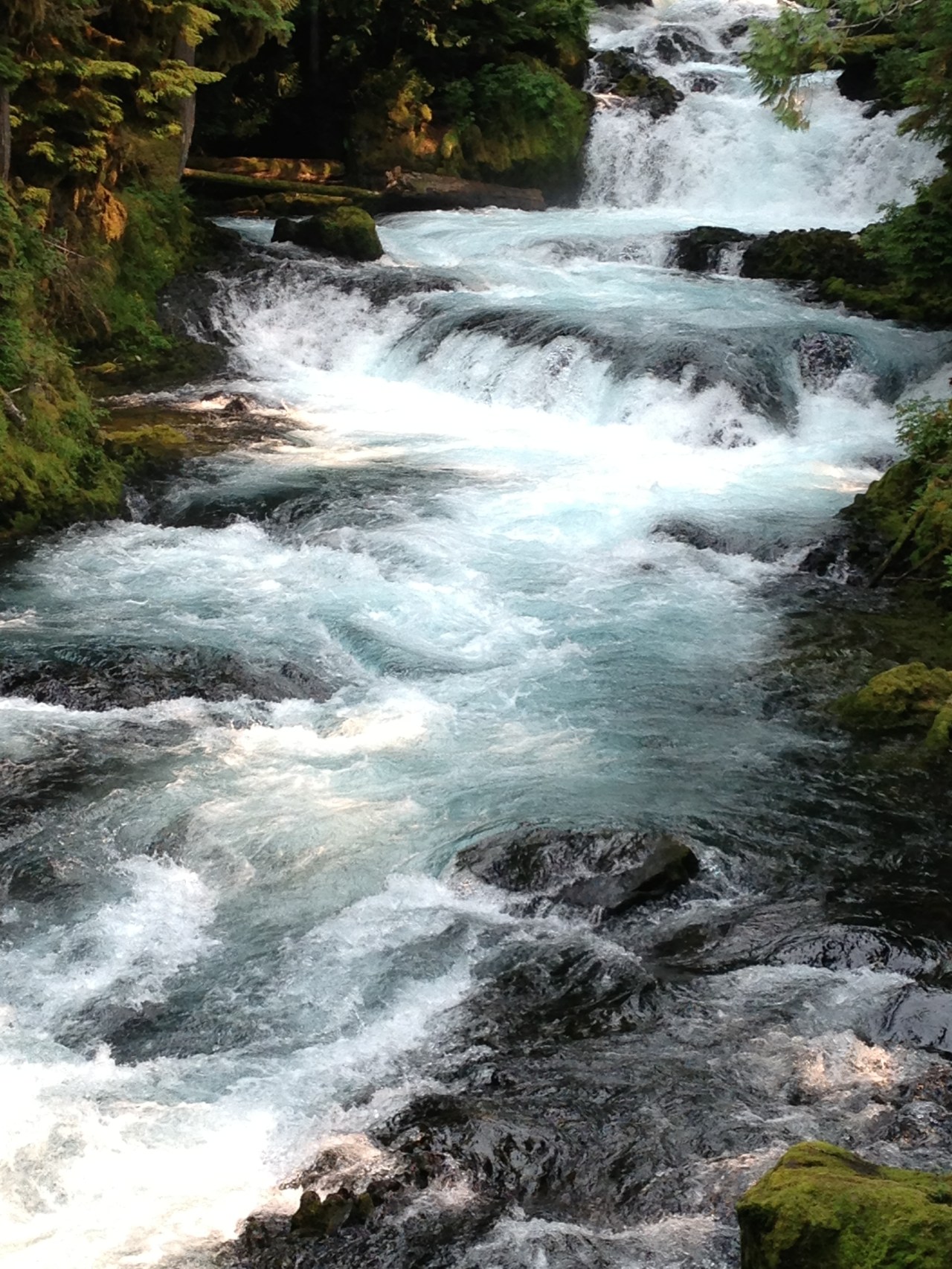
Up From the River Smiling

A friend once told me she met

her future husband just after

a turbulent river tossed

her out of her small kayak.

My friend, being who she is, showed

up from beneath the icy water

laughing — her bright smile stretched

across her triumphant face.

The man, knowing his own need,

asked, “who is this woman

that came up from dangerous

water smiling?”

He asked to meet her on dry ground.

They loved well and married,

carried out to the sea of life

by that river-smiling moment.

I wonder how I, being who I am,

could meet another who is able

to come up from the river smiling.

I’m familiar with icy water, dangerous

and turbulent; I watch it carefully,

hopeful to someday see the one

who comes up from the river

with a smile on his face.